Showing posts with label New releases. Show all posts

Friday, 31 March 2023

 NEW RELEASES

Chicanes by Clara Schulmann (translated from French by Anna Clement, Ruth Diver, Lauren Elkin, Jennifer Higgins, Natasha Lehrer, Sophie Lewis, Naima Rashid, and Jessica Spivey)          $38
As she tries to collect them for an essay she is planning to write, other women’s words begin interfering in Clara Schulmann’s life — heard on the radio, in podcasts, songs, and films; words of novelists, feminist intellectuals, friends or strangers overheard in the street. They invade her psyche, reshaping the essay that she once had in mind into a picaresque adventure which investigates the fault lines around women’s voices: and in particular those moments of overflow and excess where wayward words take seed. Chicanes heralds a new French feminism through a meticulously orchestrated chorus of the wildest female voices, from figures in the history of feminist writing to the stranger on the street, blurring the boundaries between body and art; personal and political. A poly-translation, by eight female translators, from established to emerging, Chicanes brings the individual voice of each translator into subtle relief.
"This is a book to treasure and love." —Deborah Levy
>>The voice that cannot be controlled. 
Ninth Building by Zhou Jingzhi (translated from Chinese by Jeremy Tiang)          $38
Revisiting his experiences as a boy in Beijing and then as a teenager exiled to the countryside, Zou captures a side of the Cultural Revolution that is seldom talked about — the sheer tedium and waste of young life under the regime, as well as the gallows humour that accompanies such desperate situations. 
"A kaleidoscopic and understated collection of interlocking tales of life in an apartment building under the Cultural Revolution – the daily tedium of its inhabitants, lit by brief and tenuous moments of shared humanity." —judges' citation, The International Booker Prize 2023
>>Read an extract. 
>>Other books long-listed for the 2023 International Booker Prize.
Why Read: Selected writings, 2001—2021 by Will Self               $37
Self's intellectual acumen and verbal prowess have always protruded well beyond his fiction, and he never shies away from provoking whatever or whoever needs to be provoked. These essays all test the interplay between 'reality' and 'fiction', and ask how literature can help us be sharper about the problems of contemporary life.  Contents: 1: Why Read? 2: The Death of the Shelf; 3: Absent Jews and Invisible Executioners: W. G. Sebald and the Holocaust; 4: Chernobyl; 5: Kafka's Wound; 6: A Care Home for Novels: The Narrative Art Form in the Age of Its Technical Supersession; 7: The Last Typewriter Engineer; 8: Isenshard; 9: How Should We Read? 10: Junky; 11: Being a Character; 12: Australia and I; 13: The Rise of the Machines; 14: Literary Time; 15: The Printed Word in Peril; 16: The Secret Agent; 17: What to Read? 18: On Writing Memoir; 19: Apocalypse Then; 20: The Technology of Journalism; 21: St George for the French; 22: Will Self-Driving Cars Take My Job? 23: Reading for Writers.
"The finest essays here are incisive, perceptive and provocative. But they are also wildly entertaining." —Washington Examiner
"Self is the most daring and delightful novelist of his generation, a writer whose formidable intellect is mercilessly targeted on the limits of the cerebral as a means of understanding. Yes, he makes you think, but he also insists that you feel." —Guardian 
"Self often enough writes with such vividness it's as if he is the first person to see anything at all." —New York Times 
"Self has indeed been a goat among the sheep of contemporary English fiction, a puckish trickster self-consciously at odds with its middle-class politeness." —New York Review of Books 
While We Were Dreaming by Clemens Meyer (translated from German by Katy Derbyshire)       $45

Rico, Mark, Paul and Daniel were 13 when the Berlin Wall fell in autumn 1989. Growing up in Leipzig at the time of reunification, they dream of a better life somewhere beyond the brewery quarter. Every night they roam the streets, partying, rioting, running away from their fears, their parents and the future, fighting to exist, killing time. They drink, steal cars, feel wrecked, play it cool, longing for real love and true freedom. Startlingly raw and deeply moving, While We Were Dreaming is an extraordinary coming of age novel by one of Germany's most ambitious writers, full of passion, rage, hope and despair.
"The cumulative power of the well-constructed, pitiless and unflinching dispatches from the underbelly of society is remarkable. Historical events often pass unnoticed by those living through them, unaware even of how much their lives have been changed. It is Meyer’s achievement to capture the profound effects those events had on the lives of those at the bottom of German society." — David Mills, Sunday Times
"A book like a fist. German literature has not seen such a debut for a long time, a book full of rage, sadness, pathos and superstition. —Felicitas von Lovenberg, Frankfurter Allgemeine Zeitung
"Clemens Meyer’s great art of describing people takes the form of the Russian doll principle: a story within a story within a story. So much is so artfully interwoven that his work breaks the mould of the closed narrative." —Katharina Teutsch, Die Zeit
>>Read an extract.
>>Other books long-listed for the 2023 International Booker Prize.

Trench Coat ('Object Lessons' series) by Jane Tynan            $23

We think we know the trench coat, but where does it come from and where will it take us? From its origins in the trenches of WW1, this military outerwear came to project the inner-being of detectives, writers, reporters, rebels, artists and intellectuals. The coat outfitted imaginative leaps into the unknown. Trench Coat tells the story of seductive entanglements with technology, time, law, politics, trust and trespass. Readers follow the rise of a sartorial archetype through media, design, literature, cinema and fashion. Today, as a staple in stories of future life-worlds, the trench coat warns of disturbances to come.
>>Other books in the 'Object Lessons' series. 


Anaximander and the Nature of Science by Carlo Rovelli           $40
Over two millennia ago, a Greek philosopher had a number of wondrous insights that paved the way to cosmology, physics, geography, meteorology and biology, setting in motion a new way of seeing the world. Anaximander's legacy includes the revolutionary idea that the earth floats in a void, that the world can be understood in natural rather than supernatural terms, that animals evolved, and that universal laws govern all phenomena. He introduced a new mode of rational thinking with an openness to uncertainty and to the progress of knowledge.  Rovelli brings to light the importance of Anaximander's overlooked legacy to modern science. He examines Anaximander as a scientist interested in shedding light on the deep nature of scientific thinking, which Rovelli locates in his rebellious ability to reimagine the world again and again. 
Artificial Hells: Participatory art and the politics of spectatorship by Claire Bishop          $25
Since the 1990s, critics and curators have broadly accepted the notion that participatory art is the ultimate political art: That by encouraging an audience to take part an artist can promote new emancipatory social relations. Around the world, the champions of this form of expression are numerous, ranging from art historians such as Grant Kester, curators such as Nicolas Bourriaud and Nato Thompson, to performance theorists such as Shannon Jackson. Artificial Hells is the first historical and theoretical overview of socially engaged participatory art, known in the US as 'social practice'. Claire Bishop follows the trajectory of twentieth-century art and examines key moments in the development of a participatory aesthetic. This itinerary takes in Futurism and Dada; the Situationist International; Happenings in Eastern Europe, Argentina and Paris; the 1970s Community Arts Movement; and the Artists Placement Group. It concludes with a discussion of long-term educational projects by contemporary artists such as Thomas Hirschhorn, Tania Bruguera, Pawel Althamer and Paul Chan. Claire Bishop has been one of the few to challenge the political and aesthetic ambitions of participatory art. In Artificial Hells, she not only scrutinises the emancipatory claims made for these projects, but also provides an alternative to the ethical (rather than artistic) criteria invited by such artworks. Artificial Hells calls for a less prescriptive approach to art and politics, and for more compelling, troubling, and bolder forms of participatory art and criticism.

>>Where are we now? 

Tekebash and Saba: Recipes from the Horn of Africa by Saba Alemayoh               $50
A celebration of the food of Ethiopia's northernmost state Tigray, interweaved with the compelling story of author Saba Alemayoh and her mother Tekebash Gebre, who came to Australia as refugees and have nurtured a connection to their beloved homeland through shared recipes and rituals.

Victory City by Salman Rushdie          $37
In the wake of an insignificant battle between two long-forgotten kingdoms in fourteenth-century southern India, a nine-year-old girl has a divine encounter that will change the course of history. After witnessing the death of her mother, the grief-stricken Pampa Kampana becomes a vessel for the goddess Parvati, who begins to speak out of the girl's mouth. Granting her powers beyond Pampa Kampana's comprehension, the goddess tells her that she will be instrumental in the rise of a great city called Bisnaga - literally 'victory city' - the wonder of the world. Over the next two hundred and fifty years, Pampa Kampana's life becomes deeply interwoven with Bisnaga's, from its literal sowing out of a bag of magic seeds to its tragic ruination in the most human of ways: the hubris of those in power. Whispering Bisnaga and its citizens into existence, Pampa Kampana attempts to make good on the task that Parvati set for her: to give women equal agency in a patriarchal world. But all stories have a way of getting away from their creator, and Bisnaga is no exception. As years pass, rulers come and go, battles are won and lost, and allegiances shift, the very fabric of Bisnaga becomes an ever more complex tapestry - with Pampa Kampana at its center. 
The Dollhouse by Charis Cotter         $21
Alice's world is falling apart. Her parents are getting a divorce, and they've cancelled their yearly cottage trip — the one thing that gets Alice through the school year. Instead, Alice and her mother are heading to some small town where Alice's mother will be a live-in nurse to a rich elderly woman. The house is huge, imposing and spooky, and everything inside is meticulously kept and perfect — not a fun place to spend the summer. Things start to get weird when Alice finds a dollhouse in the attic that's an exact replica of the house she's living in. Then she wakes up to find a girl asleep next to her in her bed — a girl who looks a lot like one of the dolls from the dollhouse... When the dollhouse starts to change when Alice isn't looking, she knows she has to solve the mystery. Who are the girls in the dollhouse? What happened to them? And what is their connection to the mean and mysterious woman who owns the house?
Stroller ('Object Lessons' series) by Amanda Parrish Morgan         $23
Among the many things expectant parents are told to buy, none is a more visible symbol of status and parenting philosophy than a stroller. Although its association with wealth dates back to the invention of the first pram in the 1700s, in recent decades, four-figure strollers have become not just status symbols but cultural identifiers. There are sleek jogging strollers for serious athletes, impossibly compact strollers for parents determined to travel internationally with pre-ambulatory children, and those featuring a ride-on kick board or second, less "babyish" seat, designed with older siblings in mind. Despite the many models available, we are all familiar with the image of a harried mother struggling to use a stroller of any kind in a public space that does not accommodate it. There are anti-stroller evangelists, fervently preaching the gospel of baby wearing and attachment parenting. All of these attitudes, seemingly about an object, are also revealing of how we believe parents and children ought to move through the world.
Children of the Rush by James Russell            $23
It's 1861, and gold fever is sweeping the world. Otherwise sensible adults have gone mad and will do anything to get their hands on the precious metal. But two children have been caught up in the rush. Michael and Atarangi couldn't be more different, but they share one thing: each has a remarkable and magical talent. Circumstances conspire to bring the children together in the remote and inhospitable goldfields, and they're thrust into a world where lawlessness, greed, and cruelty reign. When the children find out that a cut-throat gang stalks the goldfields, preying upon the innocent, they have a choice to make: turn a blind eye, or fight back?


Friday, 24 March 2023

 NEW RELEASES

Whale by Cheon Myeong-Kwan (translated by Chi-Young Kim)       $38
An adventure-satire of epic proportions, which sheds new light on the changes Korea experienced in its rapid transition from pre-modern to post-modern society. Set in a remote village in South Korea, Whale follows the lives of three linked characters: Geumbok, an extremely ambitious woman who has been chasing an indescribable thrill ever since she first saw a whale crest in the ocean; her mute daughter, Chunhui, who communicates with elephants; and a one-eyed woman who controls honeybees with a whistle. A fiction that brims with surprises and wicked humour, from one of the most original voices in South Korea.  
"A carnivalesque fairy tale that celebrates independence and enterprise, a picaresque quest through Korea’s landscapes and history, Whale is a riot of a book. Cheon Myeong-Kwan’s vivid characters are foolish but wise, awful but endearing, and always irrepressible. This is a hymn to restlessness and self-transformation." —judges' citation, 2023 International Booker Prize
Women have always gardened, but their stories have so often been buried with their work. Alice Vincent explores what encourages women to go out, work the soil, plant seeds and nurture them, even when so many other responsibilities sit upon their shoulders. This book emerged from a deeply rooted desire to share the stories of women who are silenced and overlooked. In doing so, Alice fosters connections with gardeners that unfurl into a tender exploration of women's lives, their gardens and what the ground has offered them, with conversations (with Ali Smith, Hazel Gardiner, Cosey Fanni Tutti, and others) spanning creation and loss, celebration and grief, power, protest, identity and renaissance. 
"Alice Vincent has written something wonderful. Why Women Grow is a book that not only presents us with the beauty of the earth but asks one of the most fundamental questions to the human condition: what does it mean to create? I loved the way she wrote about the ambivalent power of the maternal question. I was delighted to travel around the country with her, digging into people's lives, private spaces and plants. We need more books about women, wombs and our role in the world; Alice has done that with charm, humour and an impressive depth of knowledge." —Nell Frizzell
Deranged As I Am by Ali Zamir (translated by Alice Banks)             $38
Set on the island of Anjouan, Comoros, Deranged As I Am follows the story of a humble dock worker. With his ramshackle cart and patched-up clothes, he spends his days trying to find enough work to feed himself. This whirlwind of a novel takes place over just a few days, yet Ali Zamir's poetic and energetic prose transports readers to the docks, its noises, colors, and smells. This lively and often darkly humorous story does not draw away from the more serious themes of class, poverty, and exploitation that Zamir explores. A rich and significant text that questions literature and language itself.
The South Island of New Zealand from the Road by Robin Morrison             $75
In 1979 the photographer Robin Morrison and his family spent seven months on the road in the South Island, where Morrison photographed people and places. The resulting book was published in 1981 by Alister Taylor and became an overnight success. Alas, conflict between Taylor and the printer, and the later loss of some images, meant it was never reprinted once it had sold out. It now has near legendary status and sells for hundreds of dollars in the used-book market. Now this groundbreaking book is back in a new edition. Morrison's original Kodachrome slides have been digitised using the latest technology, and his friend and fellow journalist Louise Callan has written a major essay on the book and its legacy, including assessments and recollections by Robin White, Laurence Aberhart, Grahame Sydney, Owen Marshall, Ron Brownson, Dick Frizzell, Alistair Guthrie and Sara McIntyre. 
The Birthday Party by Laurent Mauvignier (translated by Daniel Levin Becker)                $45
Buried deep in rural France, little remains of the isolated hamlet of the Three Lone Girls, save a few houses and a curiously assembled quartet: Patrice Bergogne, inheritor of his family’s farm; his wife, Marion; their daughter, Ida; and their neighbour, Christine, an artist. While Patrice plans a surprise for his wife’s fortieth birthday, inexplicable events start to disrupt the hamlet’s quiet existence: anonymous, menacing letters, an unfamiliar car rolling up the driveway. And as night falls, strangers stalk the houses, unleashing a nightmarish chain of events. Told in rhythmic, propulsive prose that weaves seamlessly from one consciousness to the next over the course of a day, The Birthday Party is a deft unravelling of the stories we hide from others and from ourselves, a gripping tale of the violent irruptions of the past into the present. 
"The Birthday Party is a strange and marvellous thing: a thriller in slow motion. The tension builds so patiently that you almost miss it, with the result that when shocking events occur it’s too late to turn away. This is a dark and discomfiting work of beauty and violence, made all the more disturbing by its idyllic setting." —Jon McGregor
"This impressive and fascinating book reconciles two primal feelings: empathy and dread. It is a very scary book, rooted in the traditions of horror. It is as scary as when we listened to stories about ogres and wolves as children." —judges' citation on listing the book for the 2023 International Booker Prize
Dig Where You Stand: How to research a job by Sven Lindqvist            $45
Whatever your job is, it is part of a web of relations that affect other people, and the environment too. But how can you know the effects of your work? Who holds the power of the work that you do, and what do they use it for? Dig Where You Stand is a rallying cry for workers to become researchers, to follow the money, take on the role as experts on their job, and 'dig' out its hidden histories in order to take a vital step towards social and economic transformation. This how-to guide makes the case that everyone — not just academics — can learn how to critically and rigorously explore history, especially their own history, and in doing so find a blueprint for how to transform society for the better. In a world where the balance of power is overwhelmingly stacked against the working-class, Dig Where You Stand's manifesto for the empowerment of workers through self-education, historical research and political solidarity is urgent, important and relevant..
“This pioneering work is as relevant today as it was on first publication, as capital continues to unceasingly move around the world, desperate to avoid accountability for its disastrous social and environmental consequences.” —Ken Worple
"Lindqvist’s book shows with vivid clarity how capitalism permeates society, our homes, lungs, and children’s future. And yet, at the end, there is not despair and hopelessness but an empowering sense that things can and will be changed.” —Catharina Thörn
Chinatown by Thuận (translated by Nguyen An Ly)         $36

The Métro shudders to a halt: an unattended bag has been found. For the narrator, a Vietnamese woman teaching in the Parisian suburbs, a fantastical interior monologue begins, looking back to her childhood in early ‘80s Hanoi, university studies in Leningrad, and the travails and ironies of life in France as an immigrant and single mother. But most of all she thinks of Chinese-Vietnamese Thụy, who she married in the aftermath of the Sino-Vietnamese war, much to her parents’ disapproval, and whom she has not seen now for eleven years. The mystery around his disappearance feeds her memories, dreams and speculations, in which the idea of Saigon’s Chinatown looms large. There’s even a novel-in-progress, titled I’m Yellow, whose protagonist’s attempts to escape his circumstances mirror the author-narrator’s own. Interspersed with extracts from I’m Yellow, the narrator's book-length monologue is an attempt, at once desperate, ironic, and self-deprecating, to come to terms with the passions that haunts her.
“Chinatown exerts a near-tidal pull on the reader. I swallowed it down in one gulp.” — Lily Meyer
“Chinatown is a fever dream, a hallucination, a loop in time and life that Thuân masterfully deploys to capture the disorienting and debilitating effects of migration, racism, and a broken heart in both Vietnam and France. I was completely immersed in this spellbinding novel.” — Viet Thanh Nguyen

The Earth Transformed: An untold story by Peter Frankopan              $45
 Following his Silk Roads books, Frankopan turns his attention to our ancestors who, like us, worshipped, exploited and conserved the natural environment — and draws salutary conclusions about what the future may bring. In this book, Frankopan shows that engagement with the natural world and with climatic change and their effects on us are not new — exploring, for instance, how the development of religion and language and their relationships with the environment; tracing how growing demands for harvests resulted in the increased shipment of enslaved peoples; scrutinising how the desire to centralise agricultural surplus formed the origins of the bureaucratic state; and seeing how efforts to understand and manipulate the weather have a long and deep history. Understanding how past shifts in natural patterns have shaped history, and how our own species has shaped terrestrial, marine and atmospheric conditions is not just important but essential at a time of growing awareness of the severity of the climate crisis.
Stagioni: Modern Italian cooking to capture the seasons by Olivia Cavalli           $54
Stagioni, meaning 'seasons' in Italian, will take you on a journey through the culinary year with recipes for every craving and occasion. Chef and food writer Olivia Cavalli brings together traditional recipes and contemporary creations with an enthusiastic aim to put fruit and vegetables centre stage. From refreshing summer salads to steaming bowls of wintery pasta, you'll find classics such as aubergine parmigiana, stuffed tomatoes and amaretti peaches alongside more unusual combinations of chestnut gnocchi, grape focaccia and courgette cake. Nicely done. 
The Remains by Margo Glantz (translated by Ellen Jones)           $38
The way you hold a cello, the way light lands on a Caravaggio, the way the castrati hit notes like no one else could—a lifetime of conversations about art and music and history unfolds for Nora García as she and a crowd of friends and fans send off her recently deceased ex-husband, Juan. Like any good symphony, there are themes and repetitions and contrapuntal notes. We pingpong back and forth between Nora's life with Juan (a renowned pianist and composer, and just as accomplished a raconteur) and the present day (the presentness of the past), where she sits among his familiar things, next to his coffin, breathing in the particular mix of mildew and lilies that overwhelm this day and her thoughts. In Glantz's hands, music and art access our most intimate selves, illustrating and creating our identities, and offering us ways to express love and loss and bewilderment when words cannot suffice. As Nora says, "Life is an absurd wound: I think I deserve to be given condolences." Glantz fuses Yiddish literature, Mexican culture, and French tradition to create an experimental new work of literature.
"An erudite meditation on the link between mortality and the nature of art." —Publishers Weekly
"Reading Margo Glantz's virtuoso novel is like letting oneself go while listening to Glenn Gould interpret Mozart." —Ilan Stavans
Iris and Me by Philippa Werry          $25
In January 1938 Iris Wilkinson—better known by her pen name Robin Hyde— left New Zealand for England. On the way, intrigued by glimpses of China, she ventured inland despite the war raging there, becoming one of the first female war correspondent—a feat that was all the more remarkable because she struggled with mental health and suffered a disability that meant she had a lifelong limp. Her story—here presented in verse form—is narrated by a loyal but mysterious companion who asks the reader to guess their secret.


Arabesques by Anton Shammas (translated by Vivian Eden)          $46
Arabesques engages with history and politics not as propaganda but as literature. That engagement begins with the language in which the book is written: Anton Shammas, from a Palestinian Christian family and raised in Israel, wrote in Hebrew, as no Arab novelist had before. The choice was provocative to both Arab and Jewish readers. Arabesques (first published in 1988) is divided into two sections: 'The Tale' and 'The Teller'. 'The Tale' tells of several generations of family life in a rural village, of the interplay of past and present, of how memory intersects with history in a part of the world where different people have both lived together and struggled against each other for centuries. 'The Teller' is about the writer's voyage out of that world to Paris and the United States, as he comes into his vocation as a writer, and raises questions about the authority of the storyteller and the nature of the self. Shammas's tour de force is both a personal and a political narrative—a reinvention of the novel as a way of envisioning and responding to historical and cultural legacies and conflicts.
"Intricately conceived and beautifully written. A crisp, luminous, and nervy mixture of fantasy and autobiography and an elegant example of postmodern baroque." —John Updike, The New Yorker
"If Hebrew literature is at all destined to have its Conrads, Nabokovs, Becketts and Ionescos, it could not have hoped for a more auspicious beginning." —Muhammad Siddiq, Los Angeles Times 
How to Get Fired by Evana Belich             $37
Wry and astute, these linked short stories all deal with work in Aotearoa — how to get it, avoid it, or lose it. In 'BurgerKai', Mel is given a motivational talk on what she says is "failing at a stupid, screwed-up sales job, selling stupid plastic shelving". Her days at Pacific Wave Plastics are numbered. Meanwhile, in the next story, Vic bikes through Christchurch collecting mementoes from the houses she has lived in, while her ex-partner Emma makes the decision to move to Auckland to work at a plastics factory... And so the chain continues — characters walk from one story to the next, often oblivious to each other, perhaps related through colleagues, or having once attended the same school, or simply crossed paths on a beach that offers escape from work. Oblique connections unite them, as does their daily struggle to negotiate relationships while they try to survive employment, or avoid it, or face getting fired.
"Reading these stories was an utterly absorbing experience. Belich demonstrates insider knowledge of unions and working conditions in real peoples' everyday lives with a profound compassion that is never sentimental. Her characters are deeply observed as they thread their way in and out of loosely linked narratives. I was reminded of Elizabeth Strout's wonderful Olive Kitteridge. I kept catching my breath as I came across familiar detail presented with a fresh and loving eye; this is simply a must-read." —Fiona Kidman
Millions of people climb the grand marble staircase to visit the Metropolitan Museum of Art every year. But only a select few have unrestricted access to every nook and cranny. They're the guards who roam unobtrusively in dark blue suits, keeping a watchful eye on the two million square foot treasure house. Caught up in his glamorous fledgling career at The New Yorker, Patrick Bringley never thought he'd be one of them. Then his older brother died of cancer and he found himself needing to escape the mundane clamor of daily life. So he quit The New Yorker and sought solace in the most beautiful place he knew. To his surprise and the reader's delight, this temporary refuge becomes Bringley's home away from home for a decade. We follow him as he guards delicate treasures from Egypt to Rome, strolls the labyrinths beneath the galleries, wears out nine pairs of company shoes, and marvels at the beautiful works in his care. Bringley enters the museum as a ghost, silent and almost invisible, but soon finds his voice and his tribe—the artworks and their creators and the lively subculture of museum guards—a mosaic of artists, musicians, blue-collar stalwarts, immigrants, cutups, and dreamers. As his bonds with his colleagues and the art grow, he comes to understand how fortunate he is to be walled off in this little world, and how much it resembles the best aspects of the larger world to which he gradually, gratefully returns.
Stolen by Ann-Helen Laestadius          $37
Nine-year-old Elsa lives just north of the Arctic Circle. She and her family are Sami, Scandinavia's indigenous people and make their living herding reindeer. One morning when Elsa goes skiing alone, she witnesses a man brutally killing her reindeer calf, Nastegallu. Elsa recognises the man but refuses to tell anyone least of all the Swedish police force about what she saw. Instead, she carries her secret as a dark weight on her heart. Elsa comes of age fighting two wars- one within her community, where male elders expect young women to know their place; and against the ever-escalating wave of prejudice and violence against the Sami. When Elsa finds herself the target of the man who killed her reindeer calf all those years ago, something inside of her finally breaks. The guilt, fear, and anger she's been carrying since childhood come crashing over her like an avalanche, and will lead Elsa to a final catastrophic confrontation.
"Stolen is an extraordinary novel. A coming-of-age-story you'll get lost in, about youth and heritage and the never-ending struggle to be allowed to exist. Although set in the coldest and most northern part of Scandinavia, I'm convinced it's a universal story to be loved everywhere in the world." —Frederik Backman
The Hotel Witch by Jessica Miller          $21
Sometimes the simplest spells are the most powerful. Sibyl is the apprentice hotel witch at the splendid Grand Mirror Hotel. She is busy each day, under the watchful eye of her grandmother, drawing useful spell patterns to keep the hotel guests happy — spells to shine shoes, spells to make the pastry chef's cakes rise, spells to remove dust and spells to return lost things like hats and gloves to their owners. But Sibyl dreams of other possibilities-possibilities like her mother returning from the Black Mountains, and like Grandma letting her draw spell patterns from the Book of Advanced and Dangerous Magic. When Grandma gets stuck in last Tuesday, somewhere on the hotel's thirteenth floor, Sibyl must perform all the magic herself. Just when a very mysterious and perplexing problem arises and a very important guest must be taken care of. With the help of her friend Ahmed, the lift attendant, an aloof cat called Alfonso and Dora the concierge, Sibyl must solve the mystery of the missing shadows and find the right spell pattern to get them back. Will she open the Book of Advanced and Dangerous Magic? And will it contain the answers she needs?


Friday, 10 March 2023

 NEW RELEASES

We will be giving away a copy of the remarkable Renters United! / Lawrence & Gibson Publishing tabloid-format! illustrated! edition of Murdoch Stephens's biting and hilarious RAT KING LANDLORD with every book order we dispatch (until supplies are exhausted). And if you order a Lawrence & Gibson book we will put in a bonus copy!
>>Read Stella's review of RKL. 
>>Books from L&G.

Affinities by Brian Dillon             $40
What do we mean when we claim affinity with an object or picture, or say affinities exist between such things? Affinities is a critical and personal study of a sensation that is not exactly taste, desire, or allyship, but has aspects of all. Approaching this subject via discrete examples, this book is first of all about images that have stayed with the author over many years, or grown in significance during months of pandemic isolation, when the visual field had shrunk. Some are historical works by artists such as Julia Margaret Cameron, Dora Maar, Claude Cahun, Samuel Beckett and Andy Warhol. Others are scientific or vernacular images: sea creatures, migraine auras, astronomical illustrations derived from dreams. Also family photographs, film stills, records of atomic ruin. And contemporary art by Rinko Kawauchi, Susan Hiller and John Stezaker. Written as a series of linked essays, interwoven with a reflection on affinity itself, Affinities is an extraordinary book about the intimate and abstract pleasures of reading and looking.
"This is a deeply personal enterprise but Dillon goes to great lengths to keep at a distance. The collection may amount to a sort-of autobiography but each essay is about the life of the artist or the work itself, not about him. He is careful of his subjects and scrupulous in neither over-interpreting them nor projecting his emotions on to them. Nevertheless, each means something profound to him and each is a pixel that builds into a creative work of his own: a picture of his own aesthetic and the constituent parts of its canon." —Michael Prodger, New Statesman
The Rest Is Slander: Five stories by Thomas Bernhard (translated by Douglas Robertson)           $40
"The cold increases with the clarity," said Thomas Bernhard while accepting a major literary prize in 1965. That clarity was the postwar realisation that the West's last remaining cultural reference points were being swept away by the ever-greater commodification of humankind. Collecting five stylistically transitional tales by Bernhard, all of which take place in sites of extreme cold, this volume extends his bleak vision.
In 'Ungenach', the reluctant heir of an enormous estate chooses to give away his legacy to an assortment of oddballs as he discovers the past of his older brother, who was murdered during a career in futile colonialist philanthropy. In 'The Weatherproof Cape', a lawyer tries to maintain a sense of familial solidarity with a now-dead client with the help of an unremarkable piece of clothing. 'Midland in Stilfs' casts a jaundiced eye on the laughable efforts of a cosmopolitan foreigner to attain local authenticity on a moribund Alpine farmstead. In 'At the Ortler', two middle-aged brothers—one a scientist, the other an acrobat—meditate on their unusual career paths while they climb a mountain to reclaim a long-abandoned family property. And in 'At the Timberline', the unexpected arrival of a young couple in a mountain village leads to the discovery of a scandalous crime that casts a shadow on the personal life of the policeman investigating it.
Ten Planets by Yuri Herrera (translated by Lisa Dillman)          $34
The characters that populate Yuri Herrera's remarkable collection of stories inhabit imagined futures that reveal the strangeness and instability of the present. Drawing on science fiction, noir, and the philosophical parables of Borges's Fictions and Calvino's Cosmicomics, these very short stories signal a new dimension in the work of this significant writer. In Ten Planets, objects can be sentient and might rebel against the unhappy human family to which they are attached. A detective of sorts finds clues to buried secrets by studying the noses of his clients, which he insists are covert maps. A meagre bacterium in a human intestine gains consciousness when a psychotropic drug is ingested. Monsters and aliens abound, but in the fiction of Herrera, knowing who is the monster and who the alien is a tricky proposition. This collection of stories, which ranges from philosophical flights of fancy to the gritty detective story continues to develop Herrera's exploration of the mutability of borders, the wounds and legacy of colonial violence, and a deep love of storytelling in all its forms.
Owlish by Dorothy Tse (translated by Natascha Bruce)            $40
In the mountainous city of Nevers, there lives a professor of literature called Q. He has a dull marriage and a lacklustre career, but also a scrumptious collection of antique dolls locked away in his cupboard. And soon Q lands his crowning acquisition: a music box ballerina named Aliss who tantalizingly springs to life. Guided by his mysterious friend Owlish and inspired by an inexplicably familiar painting, Q embarks on an all-consuming love affair with Aliss, oblivious to the sinister forces encroaching on his city and the protests spreading across the university that have left his classrooms all but empty. Thrumming with secrets and shape-shifting geographies, Dorothy Tse’s extraordinary novel is a boldly inventive exploration of life under repressive conditions.
"Beguilingly eerie, richly textured, the pages of Owlish are drenched in strange beauty and menace. Like all the best fairy tales, it reveals the dark truths that we would rather not look at directly, and does so with a surreal and singular clarity." —Sophie Mackintosh
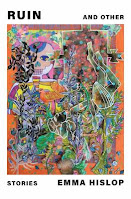
Ruin, And other stories by Emma Hislop          $30
Women and girls walk a perilously thin line between ruin and redemption in these stories as they try-with varying degrees of success-to outmanouver the violence that threatens to define their lives.There's the physical violence of men against their bodies—and sometimes the violence they exact in revenge. While doubts about a romantic partner, an abandonment by a sister, the fallout of a parent's pornography addiction, the betrayal of a friend, even the desire to touch a stranger's fur-like body are subtler aggressions that pack their own kinds of punches. Moving between contemporary New Zealand and London, and a dreamlike landscape that isn't quite real, this debut collection shimmers with a brutal kind of hope, exploring power and its contortions, powerlessness and its depravities, and the ends to which we will go to claim back agency.
Still Life by Zoë Wicomb            $36
Juggling with our perception of time and reality, Still Life tells the story of an author struggling to write a biography of long-forgotten Scottish poet and abolitionist Thomas Pringle. A multitude of voices across time, place and the lines of fiction and history—from the spectre of Mary Prince to Virginia Woolf's own Sir Nicholas Green—vie for the reader's attention. Their adventures through time and space, from Victorian South Africa and London to the author's desk in Glasgow in the present day, offer a poignant exploration of colonial history and racial oppression.
"An intriguingly metatextual novel that addresses some of the silences and omissions of South African history, and the broader relationship of historiography, reputation, writing and memory to power.” —Simon Lewis, The Post and Courier
For Thy Great Pain Have Mercy on My Little Pain by Victoria MacKintosh          $33
A meeting of mystics. In the year of 1413, two women meet for the first time in the city of Norwich. Margery Kempe has left her fourteen children and husband behind to make her journey. Her visions of Christ which have long alienated her from her family and neighbours, and incurred her husband's abuse  and have placed her in danger with the men of the Church, who have begun to hound her as a heretic. Julian, an anchoress, has not left Norwich, nor the cell to which she has been confined, for twenty-three years. She has told no one of her own visions and knows that time is running out for her to do so.The two women have stories to tell one another. Stories about girlhood, motherhood, sickness, loss, doubt and belief; revelations more the powerful than the world is ready to hear. 
Two Sherpas by Sebastián Martínez Daniell (translated by Jennifer Croft)            $38
A British climber has fallen from a cliffside in Nepal, and lies inert on a ledge below. Two sherpas kneel at the edge, stand, exchange the odd word, waiting for him to move, to make a decision, to descend. In those minutes, the world opens up to Kathmandu, a sun-bleached beach town on another continent, and the pages of Julius Caesar. Mountaineering, colonialism, obligation—in Sebastián Martínez Daniell's prose each breath is crystalline, and the whole world is visible from here.
>>The author's voice. 
A Case with a Bang ('Detective Gordon #5) by Ulf Nilsson, illustrated by Gitte Spee          $20
Inspector Gordon and Detective Buffy are back (and not just for the cake) in the final story in this fun and funny series for young readers. Night brings a horrible humming, scraping sound in the forest. Someone has wrecked the badger’s trash can. Later, three large creatures are spotted up on the mountain. Detective Buffy discovers this seemingly small case really is a dangerous mystery—she comes back from her first investigation flat as a gingerbread, rolled over by something huge and terrifying. Back at the station, retired Detective Gordon is training a new young police assistant, and the cakes have run out in the forest bakery! While all the animals cower at the police station, Buffy remembers Gordon’s stories about trolls. Is it possible they do exist? Taking Gordon’s advice about how everyone thinks differently, she finds a way to communicate with the giant creatures—perhaps not so terrifying after all. The book leaves readers with a memorable Gordon message: Everyone thinks differently, strangers are welcome, cakes for everybody! 
The Drinking Game by Guyon Espiner            $37
Four years ago, investigative journalist Guyon Espiner gave up drinking alcohol. He had been a heavy yet controlled drinker since his teens — abstaining three nights a week but making up for it the other four. One morning he woke up after a big night and decided he'd had enough and he quit — no AA, no support groups. Not drinking has given Guyon a new perspective on our relationship with alcohol in Aotearoa, and a lot of it is disturbing. The Drinking Game investigates the alcohol industry: the power, politics and lobbying behind our most harmful drug. Weaving together personal experience, hard research and interviews, it examines why New Zealand has such a heavy drinking culture, the harm it causes and how our attitudes to alcohol are changing. This is a sobering look into how the way you drink is shaped not only by your individual choice, but also by government, media and big business.
>>Alcohol and identity. 
Catfish Rolling by Clara Kumagai          $20
Sora hates the catfish whose rolling caused an earthquake so powerful it cracked time itself. It destroyed her home and took her mother. Now Sora and her scientist father live close to the zones the wild and abandoned places where time runs faster or slower than normal. Sora is sensitive to these shifts, and her father recruits her help in exploring these liminal spaces.But it's dangerous there and as she strays further inside in search of her mother, she finds that time distorts, memories fracture and shadows, a glimmer of things not entirely human, linger. 
After Sora's father goes missing, she has no choice but to venture into uncharted spaces within the time zones to find him, her mother and perhaps even the catfish itself.
Old God's Time by Sebastian Barry            $37
Retired policeman Tom Kettle is enjoying the quiet of his new home, a lean-to annexed to a white Victorian Castle in Dalkey overlooking the sea. For months he has barely seen a soul, but his peace is interrupted when two former colleagues turn up at his door to ask questions about a decades-old case. A traumatic case which Tom never quite came to terms with. His peace is further disturbed by a young mother and family who move in next door, a woman on the run from her own troubles. And what of Tom's family, his wife June and their two children?
"Sebastian Barry faces down the most challenging of subjects with an unflinching pen, using blood for ink. Yet at its heart, Old God's Time is also a love story, of two souls bonded by trauma. Narrated by a retired guard who begins to lose control of his fragile senses as his past clashes with the present, it is shocking, stunning and extraordinarily brave. Barry has once again written a character for the ages." —Liz Nugent


Friday, 3 March 2023

NEW RELEASES

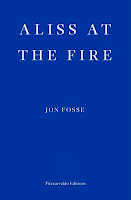
Aliss at the Fire by Jon Fosse (translated from Norwegian by Damion Searls)               $25
In her old house by the fjord, Signe lies on a bench and sees a vision of herself as she was more than twenty years earlier: standing by the window waiting for her husband Asle, on that terrible late November day when he took his rowboat out onto the water and never returned. Her memories widen out to include their whole life together, and beyond: the bonds of family and the battles with implacable nature stretching back over five generations, to Asle's great-great-grandmother Aliss. In Jon Fosse's vivid, hallucinatory prose, all these moments in time inhabit the same space, and the ghosts of the past collide with those who still live on.
"The Beckett of the twenty-first century." —Le Monde
"It is some measure of Fosse’s talents that he manages to weave such a compelling narrative from a largely static setting. Nothing really happens and yet there is something quietly dramatic about Fosse's meandering and rhythmic prose, aided by Damion Searls's limber translation, which has a strangely mesmerising effect. An intense reading experience." —Lucy Popescu, Independent
"Prose doesn’t have hooks, and Fosse’s incantations are as unexcerptable as Philip Glass symphonies or Béla Tarr tracking shots. On it goes, building layer upon layer of past and present, ancestors and loved ones, until you are immersed in that world and the prose conjures luminous glory flashing past like Blakean angels. Maybe it is convincing to say that Fosse is the only writer whose book has made me weep with emotion as I translated it." —Damion Searls
Privilege in Perpetuity: Exploding a Pākehā myth by Peter Meihana           $18
Many New Zealanders hold firm to the belief that Maori have been treated better than other indigenous peoples, and that they receive benefits that other New Zealanders do not. Some argue that the supposed privileges that Maori receive are a direct attack on the foundations of the nation. 'Privilege in Perpetuity' charts the eighteenth-century origins of this idea, tracing its development over time, and assesses what impact this notion of privilege has had on Maori communities. Central to this history is the paradox, explored by Meihana, of how Maori were rendered landless and politically marginalised, yet at the same time were somehow still considered privileged. The idea of privilege is revealed as central to colonisation in New Zealand and to the dispossession and marginalisation of Maori - and as a stubbornly persistent prejudice that remains in place today.
>>Maintaining power imbalances. 
Paris in Turmoil: A city between past and future by Eric Hazan            $28
Paris is constantly changing as a living organism, both for better and for worse. The gentrification and internal colonisation of poorer and ethnically diverse neighbourhoods are changing the city and causing new neighbourhoods to spring up elsewhere. In some thirty succinct vignettes, from bookshops to beggars, Art Nouveau to street sounds, Parisian writers to urban warts, Jacobins to Surrealism, from the Périphérique to Place Vendôme, its markets of Aligre and Belleville, its cafés and tabacs, its history from Balzac to Sartre, Hazan offers a host of invaluable aperçus that help us to see the social forces that are changing the city. 
The Looking-Glass: Essential stories by Machado de Assis (translated by Daniel Hahn)           $28
Joaquim Maria Machado de Assis is widely regarded as among the greatest Brazilian writers of all time. He was born to a poor family in Rio de Janerio and, with little formal education, took work as a typographer's apprentice and began to write and publish at age 15. Machado went on to a successful career as a writer of romantic novels and government bureaucrat. In the late 1870s he suffered a severe bout of illness, after which he wrote the ironic, complex masterpieces for which he is now famous, including The Posthumous Memoirs of Bras Cubas and Dom Casmurro. This volume collects his best short fiction, in excellent fresh translations. 

"Machado De Assis is the writer who made Borges possible." —Salman Rushdie
"The greatest writer ever produced in Latin America." —Susan Sontag
"'Another Kafka." —Allen Ginsberg
"A great writer who chose to use deadly humor where it would be least expected to convey his acute powers of observation and his penetrating insights into psychology. In superbly funny books he described the abnormalities of alienation, perversion, domination, cruelty and madness. He deconstructed empire with a thoroughness and an esthetic equilibrium that place him in a class by himself." —New York Times
"
Machado de Assis was a literary force, transcending nationality and language, comparable certainly to Flaubert, Hardy or James." —New York Times Book Review
>>The greatest writer the world has never heard of. 

Solenoid by Mercea Cărtărescu (translated by Sean Cotter)         $45
Based on Cărtărescu's own role as a high school teacher, Solenoid begins with the mundane details of a diarist's life and quickly spirals into a philosophical account of life, history, philosophy, and mathematics. One character asks another: when you rush into the burning building, will you save the newborn or the artwork? On a broad scale, the novel's investigations of other universes, dimensions, and timelines reconcile the realms of life and art. The novel is grounded in the reality of late 1970s/early 1980s Communist Romania, including long lines for groceries, the absurdities of the education system, and the misery of family life. The text includes sequences in a tuberculosis sanatorium, an encounter with an anti-death protest movement, a society of dream investigators, and an extended visit to the miniscule world of dust mites living on a microscope slide. Combining fiction with autobiography and history—the scientists Nicolae Tesla and George Boole, for example, appear alongside the Voynich manuscript—Solenoid ruminates on the exchanges possible between the alternate dimensions of life and art, as various, monstrous dimensions erupt within the Communist present.
"Solenoid is a novel made from other novels, a meticulously borrowed piece of hyperliterature. Kleist's cosmic ambiguity, the bureaucratic terror of Kafka, the enchantments of Garcia Marquez and Bruno Schulz's labyrinths are all recognizable in Cartarescu's anecdotes, dreams and journal entries. That fictive texture is part and parcel of the novel's sense of unreality, which not only blends the pedestrian and the bizarre, but also commingles many features of the literary avant-garde. Although the narrator himself is largely critical of literature he also affirms the possibility inherent in the 'bitter and incomprehensible books' he idolises. In this way, he plays both critic and apologist throughout, a delicious dialectic whose final, ravishing synthesis exists in the towering work of Solenoid itself." —New York Times

Artificial Islands: Adventures in the Dominions by Owen Hatherley           $30
Artificial Islands tests the idea that Britain's natural allies and closest relations are New Zealand, Australia and Canada, through a good look at the histories, townscapes and spaces of several cities across the settler zones of the British Empire. These are some of the most purely artificial and modern landscapes in the world, British-designed cities that were built with extreme rapidity in forcibly seized territories on the other side of the world from Britain. Were these places really no more than just a reproduction of British Values planted in unlikely corners of the globe? How are people in Auckland, Melbourne, Montreal, Ottawa and Wellington re-imagining their own history, or their countries' role in the British Empire and their complicity in its crimes? Some in Britain see these countries as a natural fit for 'union' in the wake of Brexit, but would any of them be interested in such a thing? Interesting.
Doll by Maria Teresa Hart            $23

The haunted doll has long been a trope in horror movies, but like many fears, there is some truth at its heart. Dolls are possessed—by our aspirations. They're commonly used as a tool to teach mothering to young girls, but more often they are avatars of the idealised feminine self. (The word 'doll' even acts as shorthand for a desirable woman.) They instruct girls what to strive for in society, reinforcing dominant patriarchal, heteronormative, white views around class, bodies, history, and celebrity, in insidious ways. Girls' dolls occupy the opposite space of boys' action figures, which represent masculinity, authority, warfare, and conflict. By analysing dolls from 17th century Japanese Hinamatsuri festivals, to the '80s American Girl Dolls, and even to today's bitmoji, Doll reveals how the objects society encourages girls to play with shape the women they become.
>>Other books in the excellent 'Object Lessons' series. 

Mrs Jewell and the Wreck of the General Grant by Cristina Sanders             $37
It’s 1866 and the three-masted sailing ship General Grant is on the southern route from Melbourne to London, with gold from the diggings secreted in returning miners’ hems and pockets. In the fog and the dark, the ship strikes the cliffs of the Auckland Islands, is sucked into a cave and wrecked. Only fourteen men make it ashore and one woman – Mrs Jewell. Stuck on a freezing and exposed island, the castaways have to work together to stay alive, but they’re a disparate group with their own secrets to keep and their only officer is disabled by grief after losing his wife in the wreck. A woman is a burden they don’t need. Meanwhile stories about the gold grow with the telling: who has it, where is it and how much went down with the ship.
>>Long-listed for the 2023 Ockham New Zealand Book Awards. 
Skateboard by Jonathan Russell Clark          $23
How did the skateboard go from a menacing fad to an Olympic sport? Writer and skateboarder Jonathan Russell Clark answers this question by going straight to the sources: the skaters, photographers, commentators, and industry insiders who made such an unlikely rise to worldwide juggernaut possible. Skateboarders are their own historians, which means the real history of skating exists not in archives or texts but in a hodgepodge of random and iconic videos, tattered photographs, and, mostly, in the blurry memories of the people who lived through it all. From California beaches to Tokyo 2020, the skateboard has outlasted its critics to form a global community of creativity, camaraderie, and unceasing progression.

>>Other books in the excellent 'Object Lessons' series.  

The Wondrous Wonders by Camille Jourdy                $45
Hurt by her parents' divorce and struggling to accept her new stepfamily, Jo decides to run away and live alone in the woods. But she soon discovers that she's far from alone. Jo stumbles into a fantastical world full of tiny elves, talking foxes, and mischievous, multicolored ponies known as the Wondrous Wonders. Her new friends are on a mission: rise up against Emperor Tomcat, the tyrannical leader who rules the enchanted forest they call home. Can Jo find the courage to vanquish an evil empire and get back to her family before dinnertime? A delightful graphic novel for children.
Fabric: The hidden history of the material world by Victoria Finlay        $28
How is a handmade fabric helping save an ancient forest? Why is a famous fabric pattern from India best known by the name of a Scottish town? How is a Chinese dragon robe a diagram of the whole universe? What is the difference between how the Greek Fates and the Viking Norns used threads to tell our destiny? In Fabric, Finlay spins us round the globe, weaving stories of our relationship with cloth and asking how and why people through the ages have made it, worn it, invented it, and made symbols out of it. And sometimes why they have fought for it. She beats the inner bark of trees into cloth in Papua New Guinea, fails to handspin cotton in Guatemala, visits tweed weavers at their homes in Harris, and has lessons in patchwork-making in Gee's Bend, Alabama — where in the 1930s, deprived of almost everything they owned, a community of women turned quilting into an art form. Finlay began her research just after the deaths of both her parents, and Fabric is also Finlay's own journey through grief and recovery. Now in paperback (but still available as a lovely hardback). 
Eve Bites Back: An alternative history of English literature by Anna Beer           $45
From the fourteenth century through to the present day, women who write have been understood as mad, undisciplined or dangerous. Female writers have always had to find ways to overcome or challenge these beliefs. Some were cautious and discreet, some didn't give a damn, but all lived complex, eventful and often controversial lives. Eve Bites Back places the female contemporaries of Chaucer, Shakespeare and Milton centre stage in the history of literature in English. From Julian of Norwich, Margery Kempe, Aemilia Lanyer and Anne Bradstreet, to Aphra Behn, Mary Wortley Montagu, Jane Austen and Mary Elizabeth Braddon, this book will change the way you think about our literary heritage. 
"Essential reading." —Claire Tomalin
>>Meeting minds. 

Magicborn by Peter Bunzl            $17
The Curse is changed. You'll never know. The truth is lost. The lie will grow. The year is 1726 and the Royal Sorcerer of England is on the hunt for those who are Magicborn. When Tempest is captured, she is taken to Kensington Palace alongside a boy like her, Thomas. Trapped, Tempest and Thomas find their magic flickering to life and, with it, long-buried memories. For they are the lost prince and princess of Fairyland, bound by a deadly curse. But now the fairies are coming to get them, and with the truth revealed—can they both survive?