Friday, 3 August 2018


NEW RELEASES
(They're new.)
Our Life in the Forest by Marie Darrieusecq           $35
A novel that challenges our ideas about the future, about organ-trafficking, about identity, clones, and the place of the individual in a surveillance state. In the near future, a woman writes from the depths of a forest. Her body, like the world around her, is falling apart - she's down to one eye, one kidney, one lung. Before she was a psychotherapist, treating patients who had suffered trauma. Every two weeks she visited her 'half' ' a comatose double, whose body parts were available whenever needed. As a form of resistance the woman flees, along with other fugitives and their halves. But life in the forest is disturbing too - the reanimated halves behave like uninhibited adolescents, and when she sees a shocking image of herself on video, are her worst fears confirmed?
"‘Once again, Darrieusecq gives us a passionate investigation into the deficiencies, transformations and lapses in our humanity. A little like Ray Bradbury in Fahrenheit 451, she shows how literature is our best means to disrupt functionality." - Focus Vif
>> Read an extract
>> A dream of the forest
The Trilogy of Two by Juman Malouf         $25
Identical twins Sonja and Charlotte are musical prodigies with extraordinary powers. Born on All-Hallows-Eve, the girls could play music before they could walk. They were found one night by Tatty, the Tattooed Lady of the circus, in a pail on her doorstep with only a note and a heart-shaped locket. They've been with Tatty ever since, roaming the Outskirts in the circus caravans, moving from place to place.But lately, curious things have started to happen when they play their instruments. During one of their performances, the girls accidentally levitate their entire audience, drawing too much unwanted attention. Soon, ominous Enforcers come after them, and Charlotte and Sonja must embark on a perilous journey through enchanted lands in hopes of unlocking the secrets of their mysterious past. A wonderful illustrated story.
"Full of wonders. Vivid and attractive." - Philip Pullman
>> Watch the trailer, meet the characters and read the sample
Other People's Houses by Lore Segal           $20
An autobiographical novel of Segal's experience of leaving Austria for Britain on the Kindertransports, and of living as a refugee and finally getting visas for her parents to join her. 
"Moving and newly relevant. if you translate Segal's beautiful, elliptical prose into today’s terms, her story becomes both radical and unsettling." - Guardian
Wild Land by Peter and Beverly Pickford         $90
A stunning large-format book of stunning large-format photographs of stunning large-format landscapes devoid of even the slightest human impact. You will want this. 
The Button War by Avi        $28
World War One. A small village in Poland. After the Germans bomb the schoolhouse and the long-residing Russian soldiers prepare to leave the area, Patryk’s small, isolated village is suddenly a whirlwind of activity. Inspired by the frequent comings and goings of military men, Jurek, the cruel, conniving leader of Patryk’s group of classmates, declares a daring challenge: whoever procures the best button from a soldier’s uniform gets to be king. Patryk is determined to beat Jurek at his own game, but he is no match for Jurek’s determination to win at all costs, even as the game turns deadly. 
The Wind at My Back by Paul Maunder           $35
In this personal and lyrical exploration of what it means to ride a bicycle, Maunder explores how our memories have a dialogue with landscape and how cycling and creativity are connected. 
>> Flann O'Brien's atomic theory
What We Think About When We Think About Football by Simon Critchley       $18
What happens when Critchley's pointy head is focused on the inflated sphere of a football? How can the 'beautiful game' be a way of thinking about philosophy, society, identity and poetics? 
Bogotá 39 - New Voices from Latin America        $27
39 authors under 40 years old, from 15 countries, some known; many to discover. Exciting. Gabriela Jauregui, Juan Pablo Roncone, Diego Zúñiga, Martin Felipe Castagnet, Lolita Copacabana, Diego Erlan, Mauro Libertella, Samanta Schweblin; Luciana Sousa, Carlos Manuel Álvarez, Frank Báez, Laia Jufresa, Jesús Miguel Soto, Mauro Javier Cardenas, Mónica Ojeda, Natalia Borges Polesso, Mariana Torres, Liliana Colanzi, Damián González Bertolino, Valentin Trujillo, María José Caro, Juan Manuel Robles, Brenda Lozano, Claudia Ulloa Donoso, Giuseppe Caputo, Juan Cárdenas, Juan Esteban Constaín, Daniel Ferreira, Felipe Restrepo Pombo, Cristian Romero, Sergio Gutiérrez Negrón, Carlos Fonseca, Alan Mills, Valeria Luiselli, Emiliano Monge, Eduardo Rabasa, Daniel Saldaña Paris, Gonzalo Eltesh, Eduardo Plaza.
Inappropriation by Lexi Freiman         $33
A search for belonging turns into a riotous satire of identity politics in this wildly irreverent coming-of-age story.
"Lexi Freiman is a savage writer, hilarious and brilliant, and in Inappropriation, she has reframed the traditional coming-of-age story, tackling it with irreverence and acid wit. This is a daring book, thrillingly of our moment." - Emma Cline, author of The Girls
"Inappropriation is sly and risky, but also sweet, a wickedly funny machine built to make us laugh and think. The comic novel has a bold new voice in Lexi Freiman, and she could not have come along at a better time." - Sam Lipsyte, author of The Fun Parts
Alone by Christophe Chabouté     $37
An outstanding graphic novel. On a tiny lighthouse island far from the rest of the world, a hermit lives out his existence. Every week a supply boat leaves provisions, yet the fishermen never leave their boat, and never meet him.Years spent on this deserted rock, with imagination his sole companion, has made the lighthouse keeper something more than alone, something else entirely. For him, there is nothing beyond the horizon. But, one day, a new boatman steps onto the island...  


Cloud Hotel by Julian Hanshaw         $40
Remco knows he is special. He was chosen. He thinks that God took a shine to him, when a bright light in a clear northern sky brought him to the incredible Cloud Hotel. It’s a palace of wonders, an escape from the world, and a place to be alone. Well, almost alone. But now it’s time to check out, and the hotel’s last two guests must race against time to find what’s been lost, before they overstay their welcome. Graphic novel. 
"Crisp of line and hypnotically peculiar, Hanshaw deftly suspends us between dream and reality, as good comics do. As in life, the harder we look the more we see, and the stranger things invariably become." — Shaun Tan
>> From Julian's brain
>> Not to be confused with this "luxury budget" hotel
Family: New vegetable classics to comfort and nourish by Hetty McKinnon        $40
Build a repertoire of enjoyable vegetarian food loved by families of varying backgrounds. The family stories and then-and-now photographs are delightful, too. 
Sharp: The women who made an art out of having an opinion by Michelle Dean          $38
A sharp group biography of writers who demonstrated and importance and benefits of not holding their tongues. Includes Dorothy Parker, Mary McCarthy, Hannah Arendt, Susan Sontag and Joan Didion. 
"This is such a great idea for a book, and Michelle Dean carries it off, showing us the complexities of her fascinating, extraordinary subjects, in print and out in the world. Dean writes with vigor, depth, knowledge and absorption, and as a result Sharp is a real achievement." - Meg Wolitzer, New York Times 
The First Six Books of the Elements of Euclid by Oliver Byrne       $45
First published in 1847, Byrne's book of coloured illustrations of Euclid's Elements remains a design exemplar (and preceded Mondrian's investigations into colour geometry by almost a century. 
Floral Contemporary: The renaissance of flower design by Olivier Dupon        $60
38 floral designers. 
Tyrant: Shakespeare on power by Stephen Greenblatt     $45
As an ageing, tenacious Elizabeth I clung to power, a talented playwright probed the social and psychological roots and the twisted consequences of tyranny. What Shakespeare discovered in his characters remains remarkably relevant today. He shone a spotlight on the infantile psychology and narcissistic appetites of demagogues and imagined how they might be stopped. 
"Scholarly and highly entertaining." - The Guardian
Jane Doe and the Cradle of All Worlds by Jeremy Lachlan            $23
Jane's father disappears during an earthquake and Jane must enter a dangerous place between worlds, a place with shifting rooms and magical traps, to search for him. But she is not the only one tracking her father, whose secrets have drawn the attention of sinister powers. Can Jane and her new friends prevail? The start of an exciting new series. 


Imperial Tea Party: Family, politics and betrayal, The ill-fated British and Russian royal alliance by Frances Welch            $33
Apart from the marriage of Tsarevich Nicholas to Victoria's favourite granddaughter Alix, the royal families met three times: in Balmoral, in Revel and on the Isle of Wight before Revolution removed the Russians from the equation. King George denied his Romanov cousins refuge in Britain in 1917. 


Bonkers About Beetles by Owen Davey       $30
Lots of insect information illustrated in an appealing retro style. 
>> Others in the same series
Tove Jansson: Life, art, words by Boel Westin         $33
Moomins! Sculpture! Painting! Design! Relationships! Fiction! An island!
When Galaxies Collide by Lisa Harvey-Smith        $37
The Andromeda Galaxy is rushing towards us at 400,000 kilometres an hour. This book is a guide to the night sky and its wonders (black holes, pulsars, red stars, blue stars) with a fresh urgency - when the Andromeda Galaxy collides with ours in 5.86 billion years, will we be prepared? 
Notes on a Nervous Planet by Matt Haig        $30
The societies we live in are increasingly making our minds ill, making it feel as though the way we live is engineered to make us unhappy. What can we do about this? 
Watched by Marina Budhos         $21
Naeem is a Bangledeshi teenager living in Queens, New York, who thinks he can charm his way through anything. But then mistakes catch up with him. So do the cops, who offer him an impossible choice - spy on his Muslim neighbours and report back to them on shady goings-on, or face a police record.
 “Watched will pull you into its world with magnetic, graceful power, and deeply touching scenes of immigrant life and relationships. A hauntingly perfect, potent story for this moment.”—Naomi Shihab Nye, author of Habibi 

Milkman by Anna Burns         $33
Set in an unnamed city but with an astonishing, breath-shorteningly palpable sense of time and place, Milkman is a tale of gossip and hearsay, silence and deliberate deafness. The story of inaction with enormous consequences and decisions that are never made, but for which people are judged and punished.
Long-listed for the 2018 Man Booker Prize
Front Desk by Kelly Yang         $20
Ten year-old Mia Tang moved from Hong Kong to the US for a better life, a freer life, but so far, it's a life where she runs the front desk of a motel while her parents clean rooms. And she's not even allowed to use the swimming pool. Based on the author's experience as an immigrant. 
No Friend But the Mountains: Writing from Manus Island by Behrouz Boochani          $38
Since 2013, Kurdish jounralist Boochani has been held by the Australian government of Manus island in contravention of international law. While there he has managed to surreptitiously write this book about his experiences. 
>> Boochani has also been involved in the making of this film
The Accidental Memoir by Eve Makis and Anthony Cropper        $28
A workbook of approachable prompts and exercises for life writing. 


Tuesday, 31 July 2018


REMEMBERING AND FORGETTING
A FEW BOOKS ABOUT MEMORY
{Reviews by Thomas}
Mourning Diary by Roland Barthes      $32
“Who knows? Maybe something valuable in these notes.” Does a series of notes on how a work might come to be written itself constitute a work? The day after his mother’s death in 1977, Barthes began writing observations on his mourning for her on small slips of paper. The fact that he isolated this accumulation from his other work (Camera Lucida, also addressing loss and memory, but via consideration of photography, specifically a photograph of his mother, was also written in this period) as well as intimations that making these notes into a book would bring the process of mourning to a close, rather than writing a book for posterity, as, he admits, has been the case for his previous books, suggests that had Barthes not had an unfortunate encounter with a laundry van in 1980, he might have used these notes to write a book. These notes are not that book, but it could be the case that these notes, for all their inconsistencies, vaguenesses and banalities, make a rawer and more compelling book than if they had been made into the book that Barthes had perhaps intended (this might also not be the case, of course), for the notes sketch nebulae from which diamonds might be compressed (if that was Barthes’s creative process) and demonstrate that his more rigorously intellectual works have emotional bases that they are perhaps constructed to conceal. Of his mother’s recent death (he  had shared an apartment with her for 60 years), Barthes writes, “I don’t want to talk about it, for fear of making literature out of it, although as a matter of fact literature originates within these truths.” Instead, he observes himself and his mourning: “In taking these notes, I’m trusting myself to the banality that is in me.” His loss alters the way he sees both life and literature, emphasising the significance of the seemingly banal and diminishing the importance of the seemingly profound. “Everywhere, I see each individual under the aspect of ineluctably having-to-die. And no less obviously, I see them as not knowing this to be so.” “My suffering is inexpressible but all the same utterable,” he notes. It is the very shortcomings of language, the necessity of labelling his suffering as intolerable, that makes his suffering tolerable. “The indescribableness of my mourning results from my failure to hystericise it. Maman’s death is perhaps the one thing in my life that I have not responded to neurotically. My grief has not been hysterical; doubtless, more hysterically parading my depression, I would have been less unhappy. I see that the non-neurotic is not good.” “Each of us has his own rhythm of suffering,” writes Barthes, and, despite his assurances that this will not happen (“my mourning does not wear away, because it is not continuous” (“I waver between the observation that I’m unhappy only by moments, and the conviction that in actual fact I am continually, all the time, unhappy.”)), his mourning does in fact wear away, “gradually narcissism gives way to a sad egoism.” Narcissism being a literary mode; egoism not, the diary becomes sporadic and less focused as this process advances. Early on, Barthes states, “I live in my suffering, and that makes me happy,” but eventually he has trouble maintaining his identification with his mother (“henceforth and forever I am my own mother,” he had said), and his unhappiness changes its texture: “I left a place where I was unhappy and it did not make me happy to leave it.” Eventually, observing the exhaustion of grief in the maintenance of its referents, he concludes, “we don’t forget, but something vacant settles in.”
In the Dark Room by Brian Dillon     $40
Unless we are wrested by a pervasive trauma from the entire set of circumstances which constitute our identities, which are always contextual rather than intrinsic, our memories are never kept solely within the urns of our minds, so to call them, but are frequently prodded, stimulated and remade by elements beyond ourselves, or, indeed, are outsourced to these elements. Brian Dillon’s In the Dark Room is thoughtful examination of the way in which his memories of his parents, who both died as he was making the transition into adulthood, are enacted through the interplay of interior and exterior elements (the book is divided into sections: ‘House’, ‘Things’, ‘Photographs’, ‘Bodies’, ‘Places’). It is the physical world, rather than time, that is the armature of memory: time, or at least our experience of it, is contained in space, is, for us, an aspect of space, of physical extension, of objects. It is through objects that the past reaches forward and grasps at the present. And it is through the dialogue with objects that we call memory that these objects lose their autonomy and become mementoes, bearers of knowledge on our behalf or in our stead. Memory both provides access to and enacts our exclusion from the spaces of the past to which it is bound. In many ways, when the relationship between the object and the memory seem closest, this relationship is most fraught. Photographs, which Dillon describes as “a membrane between ourselves and the world,” are not so much representations as obscurations of their subjects. The subjects of photographs both inhabit an immediate moment and are secured by them in the “debilitating distance” of an uninhabitable past. When Dillon is looking at a photograph of his mother, “the  feeling that she was manifestly present but just out of reach was distinctly painful. … Photography and the proximity of death tear the face from its home and memory and set it adrift in time.” All photographs (and, indeed, all associative objects) are moments removed from time and so are equivalents, contesting with interior memories to be definitive. Photographs, even more than other objects, but other objects also, are mechanisms of avoidance and substitution as much as they are mechanisms of preservation. Memory, illness, death all distort our experience of time, but so does actual experience, and it is this distortion that generates memory, that imprints the physical with experience “spreading itself everywhere like a disease of the retina” (in the words of George Eliot). Intense experience, especially traumatic experience, death, illness, loss, violence, occlude the normal functions of memory and push us towards the edges of consciousness, touching oblivion as they also imprison us in the actual. As Dillon found, if experience cannot be experienced all at once, the context of the experience can bear us through, but it must be revisited in memory, repeatedly, until the experience is complete, if this is ever possible. Memory will often co-opt elements of surroundings to complete itself, and, especially if associative objects are not present, it will magnify its trauma upon unfamiliar contexts, increasing the separation and isolation it also seeks to overcome. Must the past be faced as directly as possible so that we may at last turn away from it? 
Patient H.M.: A story of memory, madness and family secrets by Luke Dittrich        $30
In 1953, maverick neurosurgeon William Beecher Scoville performed a groundbreaking operation on a 27-year-old epileptic patient named Henry Molaison. The operation failed to eliminate Molaison's intractable seizures, but it did have an unintended effect: Henry was left profoundly amnesic, unable to create long-term memories. In a time when all neurological knowledge was based upon aberration and dysfunction, what was learned from this misadventure about both the neurological and the functional aspects of memory? 
>> More about Moliason
Landscapes of the Metropolis of Death by Otto Dov Kulka       $28
A child exposed to experiences of a kind and scale that cannot be assimilated will create their own mythology to make life liveable. Otto Dov Kulka was a child in Auschwitz, and went on to become a prominent historian of the Holocaust. This book is remarkable as it deals specifically with the internal aspects of surviving in an intolerable situation, young Otto’s ‘Metropolis of Death’. One of the tragedies of the Holocaust was the way in which millions of people, each with their own personal narrative, were subsumed by a single narrative (one which led to the gas chambers and crematoria). It is unfortunate that even many of the most sympathetic portrayals and histories tend to reinforce the single narrative, the erasure, and it is interesting to read Kulka express his feelings of alienation when reading or watching accounts of concentration camp experiences. One of Kulka’s achievements in this deeply thoughtful book is to show how an individual can retain that individuality, and even find a sort of beauty and meaning, even under the irresistible weight of a subsuming narrative such as the ‘immutable law of the Great Death’.

The Years by Annie Ernaux 
“She will go within herself only to retrieve the world,” writes Annie Ernaux in this astounding work of what she terms “impersonal autobiography”. Conspicuously not a memoir, unless it is a memoir of time itself, the book takes the form of a ‘flat’, rigorous and unsentimental serial accumulation of moments that would otherwise be lost from human experience, moments shorn of interpretation or context, impressions that the author has resisted the expectation to turn into a narrative. Thus preserved in the nearest possible state to experience, the memories retain the power of memories without being condensed into fact, they retain the power to resonate in the reader in the way in which the reader's own memories resonate. Although the memories are often very personal and specific, covering every detail of Ernaux’s life from childhood to old age, Ernaux never presents them as belonging to an ‘I’, always to a ‘she’ or a ‘we’. She does not presume a continuity of self other than the self that exists in the moment of experience, a moment that will continue until that memory is extinguished. The distancing of the memory from the ‘I’, the clipping free of the experience from its subject, the creation of a text that is at once impersonal and personal, becomes a machine for the conversion of the particular into the universal, or, rather, for erasing the distinction between the two. “By retrieving the collective memory in an individual memory, she will capture the lived dimension of History.” At the moment that Ernaux severs her attachment from the memories that she records, she saves them from plausible extinction, she makes them the memories of others. When such responses are awakened in the reader, the reader becomes the rememberer (the rememberer in this case of living in France between 1941 and 2006). Any emotional response comes from the reader’s experience, not the author’s, or, rather, from the collective human experience that includes both reader and author. There are separate narratives, or separate modes, for what one remembers and what one knows to have happened. What is the relationship between these two kinds of memory? “Between what happens in the world and what happens to her, there is no point of convergence. They are two parallel series: one abstract, all information no sooner received than forgotten, the other all static shots,” she writes. As Ernaux reaches old age, witnessing a series of “burials that foreshadow her own,” she casts back from an imperative somewhere beyond her death, recording the rush of memory towards its ultimate forgetting. “All the images will disappear. They will vanish all at the same time, like the images that lay hidden behind the foreheads of the grandparents, dead for half a century, and of the parents, also dead. Thousands of words will suddenly be deleted the ones that were used to name things, faces, acts and feelings, to put the world in order. Everything will be erased in a second, the dictionary of words amassed between cradle and deathbed, eliminated.” But it is not only death that can extinguish memory: “The future is replaced by a sense of urgency that torments her. She is afraid that her memory will become cloudy and silent. Maybe one day all things and their names will slip out of alignment and she’ll no longer be able to put names to reality. All that will remain is the reality that cannot be spoken. Now’s the time to give form to her future absence through writing.” Her book is an attempt to “save something from the time where we will never be again.” By her method of conjuring and recording the raw material of her life, Ernaux “finds something that the image from her personal memory doesn’t give her on its own: a kind of vast collective sensation that takes her consciousness, her entire being, into itself.” The passage of time is made tangible, subjects are dissolved in their experiences, the intimate is revealed as the universal, moments are, in the act of writing, both held and relinquished.

The Mind of a Mnemonist by A.R. Luria         $60
'S' was a failure in most ways. He could never hold down a job and he found it difficult to communicate  and understand although he could learn vast tables of figures and recall them accurately seventeen years later. The strange processes of memory he evolved and his inability to forget the pains of childhood, made the simplest prose or poetry an impossible frustration, yet he could memorise whole pages of text in a language he didn't know. An almost magical use of his own imaginative powers enabled him to control his pulse and body temperature, but these same powers blurred the line that divides reality from fantasy. Luria's important study shows that a great gift is just as much a great defect, and that forgetting is essential to functioning sanity, something that a person incapable of forgetting can never achieve. Someone incapable of forgetting is perhaps as remote from having a personality as someone incapable of forming memories or someone whose memories are lost. 
Ongoingness by Sarah Manguso          $23

“Even before my body was an instrument for language it was an instrument for memory,” writes Sarah Manguso in this little book of musings on her relationship with time. With language, though, came the ability to record memory, to further the work of memory in replacing experience with a story about experience, with an ersatz 'experience' that relieves us from experience, a replacement that is, in effect, a form of forgetting, the substitution of experience with something more manageable, more assimilable. For much of her life, Manguso kept a diary, amounting eventually to more than 800 000 words, obsessively recording “what [she] could bear to remember and to convince [her]self that that was all there was.” In her diary she “files away the time that passes so I no longer need to think about it. The experience is no longer experience. It is writing.” Life as it was lived was influenced by the writing that might be done about it. Description, or the potential for description, began to cause that which was described. Time was pulled forward by the representation of its contents. Every detail recorded is an editing-out of all other possible details, each story is a deletion of all other possible stories, each path taken is a turning-away from all other possible paths. “I’d study photographs and gradually forget everything that happened between the shutter openings.” But how else may we be relieved of all those details, all those stories, all those paths, that burden us, threaten us, even, with their possibility? Manguso’s diary-keeping also arose from her desperate conception of time, from her addiction to beginnings and endings, from her inability to experience life as ongoing. “Something will happen,” she repeated to herself at a structural level. Manguso’s relationship with time changed following the birth of her son. As a new parent, and while nursing, she experienced “a new nothing, an absence of subjective experience.” Her grip, or stranglehold, on her experiences was loosened, softened, reformulated by her new role in the experiences of another. “I used to exist against the continuity of time. Then I became the baby’s continuity, a background of ongoing time for him to live against.” A reconfiguration of her attachments entailed a reconfiguration of Manguso’s world-view as well: “The experiences that demanded I yield control to a force greater than my will weren’t the beginnings or the ends of anything. They were the moments when I was forced to admit that beginnings and ends are illusory,” she writes.“I no longer believe in anything other than the middle.” No longer needing her diary to formulate experience (“Forgotten moments are the price of continued participation in life, a force indifferent to time.”), Manguso has become more aware of the ongoingness of time, the inchoate onward rush of all things for which linear time can never be more than “a summary”. Participation in life requires an acceptance of (even an enthusiasm for) mortality: “The best thing about time is the privilege of running out of it, of watching the wave of mortality break over me and over everyone I know. No more time, no more potential. The privilege of ruling things out. Finishing. Knowing I’m finished. And knowing that time will go on without me. A flash - and I’m gone, but look, the churn of bodies through the world of light.”
Stammered Songbook: A mother's Book of Hours by Erwin Mortier        $25
Memory and personality are interdependent and could be seen to be aspects of each other. Both are constructs that enable us to function practically and socially, but both are tentative, fragile and vulnerable to erosion. When Erwin Mortier’s mother developed Alzheimer’s Disease at the age of 65, her loss of memory was also a profound loss of personality and Mortier began to find it difficult to associate the memories he had of his once-vivacious mother with the person whose rapid mental and physical diminishment made her more of a lingering absence than a presence. Mortier’s book is beautifully written, intensely sad, unsentimental, unflinching and tender. His ability to use a tiny detail or turn of phrase to evoke a memory of his mother or his childhood or a step in his mother’s loss of memory and language and personality is remarkable. Written while his mother is still alive in an attempt to fix his memories of her lest they get sucked away in the slipstream of her departure, the book expresses the hope that, following her death, these memories will be freed from the mental decline which currently overwhelms them and that, through words, they may come together again to form an idea of the particular person his mother was. Perhaps our individuality, dependent as it is on language and memory, is what is gradually (or rapidly) eroded in Alzheimer’s, and what is left, the whimpering animal full of fear but occasionally responsive to small immediate comforts, is what we all have in common, what is always at our core, but which we obscure with layers of language, personality, belief and knowledge (all relatively recent evolutionary innovations) in order to function, to survive, to bear existence, to comfort ourselves and others.
W, Or, The memory of childhood by Georges Perec          $30
“I write: I write because we lived together, because I was once amongst them, a shadow amongst their shadows, a body close to their bodies. I write because they left in me their indelible mark, whose trace is writing. Their memory is dead in writing; writing is the memory of their death and the assertion of my life.” Both of Perec’s parents were killed in the 1939-1945 war, his father early on as a French soldier, and, soon after, his mother sent to a death camp. Their young son was smuggled out of Paris and spent the war years in a series of children’s homes and safe villages. “My childhood belongs to those things which I know I don’t know much about,” he writes. W alternates two narratives, the first an attempt by Perec to set down the memories of his childhood and to examine these not only for their accuracy but in order to learn the way in which memory works. Often factual footnotes work in counterpoint to the ‘remembered’ narrative, underscoring the limitations of the experiences that formed it. Right from birth the pull of the Holocaust is felt upon Perec’s personal biography, and his story is being shaped by this force, sucking at it, sucking his family and all stability away. Sometimes he attaches to himself experiences of which he was merely a witness, the memories transformed by remembering and by remembering the remembering, and so forth, and by the infection of memories by extraneous imaginative details. “Excess detail is all that is needed to ruin a memory.” The absences around which these memories circulate fill the narrative with suppressed emotion. The other narrative begins as a sort of mystery novel in Part One, telling how one Gaspard Winckler is engaged by a mysterious stranger to track down the fate of the boy whose name he had unknowingly assumed and who had gone missing with his parents in the vicinity of Terra del Fuego where they had gone in search of an experience that would relieve the boy’s mutism. In Part 2, the tone changes to that of an encyclopedia and we begin to learn of the customs, laws and practices of the land of W, isolated in the vicinity of Terra del Fuego, a society organised exclusively around the principles of sport, “a nation of athletes where Sport and life unite in a single magnificent effort.” Perec tells us that ‘W’ was invented by him as a child as a focus for his imagination and mathematical abilities during a time when his actual world and his imaginative world were far apart, his mind filled with “human figures unrelated to the ground which was supposed to support them, disengaged wheels rotating in the void” as he longed for an ordinary life “like in the storybooks”. Life and sport on W are governed by a very complex system of competition, ‘villages’ and Games, “the sole aim to heighten competitiveness or, to put it another way, to glorify victory.” It is not long before we begin to be uncomfortable with some of the laws and customs of W, for instance, just as winners are lauded, so are losers punished, and all individual proper names are banned on W, with athletes being nameless (apart from an alphanumeric serial number) unless their winnings entitle them to bear, for a time, the name of one of the first champions of their event, for “an athlete is no more and no less than his victories.” Perec intimates that there is no dividing line between a rationally organised society valuing competition and fascism, the first eliding into the second as a necessary result of its own values brought to their logical conclusions. “The more the winners are lauded, the more the losers are punished.” The athletes are motivated to peak performance by systematic injustice: “The Law is implacable but the Law is unpredictable.” Mating makes a sport of rape, and aging Veterans who can no longer compete and do not find positions as menial ‘officials’ are cast out and forced to “tear at corpses with their teeth” to stay alive. Perec’s childhood fantasy reveals the horrors his memoir is unable to face directly. We learn that the athletes wear striped uniforms, that some compete tarred and feathered or are forced to jump into manure by “judges with whips and cudgels.” We learn that the athletes are little more than skin and bone, and that their performances are consequently less than impressive. As the two strands of the book come together at the end, Perec tells of reading of the Nazi punishment camps where the torture of the inmates was termed ‘sport’ by their tormentors. The account of W ends with the speculation that at some time in the future someone will come through the walls that isolate the sporting nation and find nothing but “piles of gold teeth, rings and spectacles, thousands and thousands of clothes in heaps, dusty card indexes, and stocks of poor-quality soap.”
The Toy Catalogue by Sandra Petrignani             $30
"More than the game it's meant for, a plaything is usually remembered for its personal, incidental uses." This beautifully written and evocative alphabetical collection of short pieces about various toys, from abacus to baby doll to yo-yo to model zoo demonstrates how intimate objects become repositories of memory: experiences long forgotten gush forth in the most surprising fashion when we make contact with (or even consider) the objects we had unknowingly so loaded with that experience at some time in the past. Toys are remarkable in this regard: often accorded agency and specificity by children, they reward this dedication by delivering through time something of our lost selves. Although toys are often remembered for their "personal, incidental uses" rather than for their ostensible purposes, Petrignani's book is remarkable for showing how these "personal, incidental uses" are in fact common to all children, everywhere: who has not interacted with an abacus or a kaleidoscope in just the way that Petrignani describes? and who would have realised that these ways of interacting were not only personal?
The Book of Mutter by Kate Zambreno           $42
“Writing is a way not to remember but to forget,” suggests Kate Zembrano in this book concerning both her grieving for her mother and her struggle to be free of her mother, who in some ways became more dominating after her death than she was when alive. “Or if not to forget, to attempt to leave behind,” continues Zembrano. The past dominates the present, not so much in the way in which the present is disposed as in the disposition of our minds towards it: that which we are foolish enough to think of as ourself is dependent utterly upon memory, upon the power of what is not us in the past. This dominance by the lost and unreachable (we cannot assail its moment of power for it lies against the flow of time) is most oppressive when we are unaware of it. Paradoxically, we need to remember in order to escape the past and exist more freely (if existing freely is our predilection). But merely to open ourselves to the past through memory is insufficient to free ourselves of it. To gain control it is necessary to assume authorship, not to change what we cannot reach against time, but to create a simulacrum that is experienced in the place of the experience of the past, a replacement that alters the grammar of our servitude, simultaneously a remembering and a forgetting. “In order to liberate myself from the past I have to reconstruct it. I have been a prisoner of my memories and my aim is to get rid of them,” said Louise Bourgeois. Since her mother’s death, Zembrano’s thoughts have been increasingly focussed on her loving but dominating mother, to the extent that her mother is taking over her life (“Sometimes my mouth opens up and my mother’s laugh jumps out. A parlour trick”). Very possibly, this influence was operative when her mother was alive, but it was at least concentrated in a person who could be interacted with and reacted against. Now “she is everywhere by being unable to be located.” Zambreno’s perceptive book is a study, through self-scrutiny, of the ambivalences of grief and of memory, and also of a path beyond grief: “If writing is a way of hoarding memories - what does it also mean to write to disown?” Not that either remembering or forgetting does any favours to the departed. Without an actual person upon whom an identity, a history, a character may be postulated, and without the generation of new information, however minor, that is possible only by living, the definition of that person belongs to anyone and no-one. Identity becomes contested in the absence of the arbiter. What remains but the impress, somewhere in the past, the shape of which must henceforth suffice as a stand-in for the departed? For better or for worse the pull is to the past, towards the unalterable occurrences that have what could almost be considered as a will to persist through whatever has received their impress. And the struggle for authorship is complicated by the persistence of objects. Death instantaneously transforms the everyday into an archive. Zembrano’s visits to her parents’ house in the years after the death of her mother brings her into contact with objects that have lost their ordinariness, the possessions of her mother’s that her father wishes to enshrine, objects that have stultified, that have not been permitted to either lose or accrete meaning. Both comfort and trap, the archive preserves the dominance of the past per se, preserves the fact of loss more than that which has been lost. Advances in medical science have meant that more of our lives, and more of the end period of our lives, has come to be defined by illness. Increasingly few of us reach our end without being overwritten by the story of its approach. Zembrano captures well her mother’s struggle with the disease that killed her, not so much over the her survival or otherwise as over how she would be remembered, over whether the idea others had of her would be replaced by the story of a disease. All memory proceeds as a scuffle between selection and denial, between nostalgia and resentment, between freedom and attachment, between the conflicting needs of actuality and representation. Memory is the first requirement of forgetting. 


Saturday, 28 July 2018


BOOKS @ VOLUME #85 (28.7.18)

Books new and recommended, events, competitions. 


A Weekend in New York by Benjamin Markovits   {Reviewed by STELLA}
The Essingers are landing en masse in New York. First to arrive are the parents, Bill and Liesel, end-career academics, flying in from Arizona. Paul, their New York son is insistent that his wife Dana collects them from the airport despite the inconvenience to their child’s routine and her discomfort at being the first to greet his parents. Next, Jean, the youngest, flipping from understanding to irritable, arrives from London carrying a secret that she wishes to offload. Then Nathan, the eldest and successful law academic, arrives with his two girls in tow. And finally there's the emotional middle child, Susie, with her eldest son Ben, waiting to be judged and sidelined. The siblings arrive over the weekend, as they have for a least a decade, to watch Paul play tennis in the US Open. He’s a professional, semi-successful, top-100 player but he’s peaked (lower than expected) and is on his way down. He wants out and is planning his retirement at 33, much to the disappoint of Bill, and his plans to move to Texas are a surprise to his wife. Benjamin Markovits takes the Essinger family, Jewish and German, with their migrant, working-class backgrounds (Bill’s uncle founded a grocery chain, which started with humble beginnings in lower New York), their successes - academic, sporting and financial - and exposes them down to the core. In doing so he exposes the granular details of contemporary American society, with its prejudices, intolerances, politics, passions, expectations and hypocrisies. Markovits is never polemic or obvious. He keeps the palette small: a family with all its quibbles and care, stuck together, without space to breathe (just as family gatherings can be), over a short period of time - a weekend in New York. The novel moves from Friday night through to Monday morning in an unrelenting and sometimes affectingly repetitive pattern, culminating in all sitting court-side at the first match. Cleverly written, the detailed scenarios dig deep into minutiae as the family traipse around New York and sit around the table eating, arguing, reliving their childhoods and catching up. The viewpoint segues with ease from one character to the next, giving equal weighting and sympathy to all the family members. All the petty emotions are there, alongside the meaningful ones. Liesel wants to retire and move to New York - they are even looking at apartments (Nathan has organised these) - Bill has no intention of leaving Texas - a place where he feels free of his family past. Nathan is considering a move into political bureaucracy and his usually self-assured confidence is being buffeted by doubt and by Jean’s righteousness - or is she right? Jean is at a loss - unhappy but fooling herself that her life is finally on a grown-up trajectory. Susie, the child who gave up her career for children, is constantly looking for approval. Paul, focused on the match ahead, is increasingly remote. This is a story about family, what holds it together, the common threads and experiences that bind each to the other, the shared histories and the past that defines the generations that follow. Markovits uses the Essingers to explore and expose pre-Trump upper-middle-class America and reveal the cracks that can spread through a ‘happy’ family (or a contented society). A Weekend in New York will make you engage with the finest detail but leave you thinking widely. 


Pond by Claire-Louise Bennett   {Reviewed by THOMAS}
“English, strictly speaking, is not my first language by the way. I haven’t yet discovered what my first language is so for the time being I use English words in order to say things.” Always hinting at experience just beyond the reach of language, Bennett's book is impelled by the rigours of noticing. Encounters with persons and with the infraordinary are treated with equivalence: acute, highly acute, overly acute, observations immediately plunge the narrator’s awareness into the depths of her response (“My head is turned by imagined elsewheres and hardly at all by present circumstances.”), far from the surface at which outward contact may be made, or may be being made, a process that is both deeply isolating, terrifying and protective. Bennett’s unsparingly acute observations of the usually unacknowledged or unacknowledgeable motivations, urges and responses that underlie human interaction and quotidian existence seem here induced by an acceptance or a resignation that is enabled by despair, or is indistinguishable from despair, both a resignation and a panic, perhaps, a panic on the edge of self-dissolution which is perhaps our last resistance to self-dissolution and therefore fundamental to individual existence: the anxiety which all human activity is designed to conceal. Bennett’s is a very individual voice (click here to hear her read a sample), resonating at times with other works of irredeemably isolated interiority, such David Markson’s superb  Wittgenstein’s Mistress or the suppressed hysteria of Thomas Bernhard’s narrators, but tracking entirely her own patterns of thought (I have perhaps made an error here of conflating the author with the narrator, but, if this is an error, it is one hard to avoid in the book in which style and content are inseparable) with an immediacy that precludes the artificially patterning, pseudo-assimilable explanation of a ‘story’. In one excellent section, ‘Control Knobs’, the narrator describes the gradual disintegration of the three knobs that control her cooker and speculates a coming time when the last interchangeable knob breaks and the cooker will become unusable. This reminds her of the counted matches in Marlen Haushofer’s The Wall (another novel of irredeemably isolated interiority), which mark the time to the point at which that narrator will no longer be able to light a fire to cook and warm herself. Following a discussion of Bennett’s narrator’s reading and misreading of that book, she returns to an account of the ultimate hopelessness of her attempts to procure new knobs for her cooker. “I feel at a loss for about ten minutes and it’s a sensation, I realise, not dissimilar to indifference. So, naturally, I handle it rather well.”

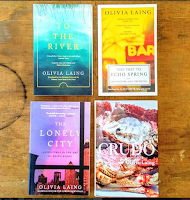
BOOK OF THE WEEK:
Is love possible in a world in the throes of political and environmental crises? The protagonist of Crudo very much resembles the book's author, Olivia Laing (with some notable intrusions from Kathy Acker), whose 2017 summer and marriage is related in this enjoyable roman-à-clef in ‘real time’ (whatever that means).

>> Read Thomas's review

>> Read an extract from the novel.

>> How to write a novel in seven weeks

>> Which books inspired Crudo?

>> What should we make of Laing's obsession with Kathy Acker?

>> The official Crudo playlist.

>> Why is there a fly on the covers of both the UK (Picador) and US (W.W. Norton) editions of Crudo? What has Laing to say about the UK cover?

>> Other excellent books by Olivia Laing (click through to learn more): 

The Lonely City: Adventures in the art of being alone
When Laing moved to New York in her mid-thirties, she found herself inhabiting loneliness on a daily basis. Increasingly fascinated by this most shameful of experiences, she began to explore the lonely city by way of art. 

The Trip to Echo Spring: On writers and drinking
What is the link between alcohol and creativity? Is there a link?

To the River: A journey beneath the surface
Over sixty years after Virginia Woolf drowned in the River Ouse, Olivia Laing set out one midsummer morning to walk its banks, from source to sea. Along the way, she explores the roles that rivers play in human lives, tracing their intricate flow through literature, mythology and folklore.