Monday, 9 May 2022


STORY SOVEREIGNTY

An interview with WHITI HEREAKA
author of KURANGAITUKU

Stella: The first striking element that readers will notice with this novel is the structure — the two starting points and the intersection of these visually in the book. The two parts are distinct, although intricately related, and have their own tone. Why did you decide to approach your novel in this manner?


Whiti: I think I spent a long time fighting against the structure that this novel finally took on — I tried very hard to write it as a lineal, chronological story! But the story presented in that way was always lacking to me. While I was trying to force it into a “normal” structure it had already separated into the different strands of the story for me — part of my struggle when I was trying to make it into a lineal story was to make the different parts of the book sit together. So this approach solved some of those problems which is great! But really this structure came about because I wanted the novel to read like how a pūrākau would be told — I worked on the rhythms of English so it would read like Te Reo Māori, and I was very well supported by the editors at Huia to do this.


Time and the experience of deep time was also important to me — a creature like Kurangaituku wouldn’t experience time in the same way we do, so I wanted to replicate that in her story. I wrote Legacy while I had put this novel on hold, and I think you can see me figuring out time loops and how to use structure as a vital storytelling component in that novel.


I also wanted to push myself as a writer and because I’ve written across genre and forms I’m interested in how far you can push a novel, I’m interested in the experience of reading a novel and how that experience is unique to the form.


It was also cool! I think ye olde thespian in me is still wanting to put on a show, to put bums on seats — and I think there’s a sort of delight in turning the book when Kurangaituku’s world is overturned, in seeing the story strands weaving together. Again, I have to thank the design team at Huia for taking my outlandish plans and making them work beautifully (in the mechanical sense and the aesthetic!)


Stella
: I was struck by Kurangaituku's curiosity and circumspect attitude towards humans. It reminded me of Max Porter's Papa Toothwort character in Lanny — listening in and watching — both standing outside of the action, but wanting to be noticed. Does Kurangaituku desire legitimacy or a place to stand, to be recognised as worthwhile? And do think wahine Maori have this same concern?


Whiti: Oh, I don’t know if I can presume the desires of Kurangaituku nor those of wāhine Māori! I don’t think either need to seek legitimacy or recognition from anyone — they are inherently so. I think what is important to Kurangaituku and Māori is story sovereignty, hell, sovereignty full stop — but that is a much bigger conversation. I think it is important for people to be able to tell their own stories in their own ways — and I think it is helpful for readers to read stories that are told from their cultural view point (and for those not of the culture to spend a bit of time in those stories too.)


Stella
: This is a visceral novel full of passion and anger. What is the role of literature in confronting violence?


Whiti: I think literature should both reflect the world and comment on it — at least, I hope that’s what I do in my mahi.


I think the violence in Kurangaituku both in the action and the character is shown to be ultimately hollow and toxic. Without giving too much away, some of the most gory scenes the violence amounts to nothing and the actors playing out the violence are stuck in a loop — nothing changes because of the violence, it is a useless waste of energy. Often when Kurangaituku herself uses violence, it frustrates her efforts to get what she wants.


I think the anger of Kurangaituku is different from her violence because it is creative — her anger spurs her exploration and her need to tell her story.


Stella
: Kuranagituku is a feminist retelling. Do you see yourself as exploring similar territory as Angela Carter in her Bloody Chamber stories and the more recent wave of feminist retellings of Greek myths? And do you feel a responsibility to articulate these often silenced voices? 


Whiti: Wow — I don’t think I can dare to say my name and Angela Carter in the same breath . Angela Carter! While I think Kurangaituku is a feminist retelling, I think more importantly it is an attempt at a decolonised retelling. Because the only place where the women’s voices in pūrākau have been silenced are in the retellings that originated with British ethnologists that published our stories and put their own patriarchal lens on them. It is unfortunate that those retellings of our stories have become those that we are most familiar with.


Being a Māori writer means always having the responsibility of articulating the voices of a community, whether I intend to do that or not! No matter what my work is there will always be the question about how that reflects on Te Ao Māori as a whole. I try my best and I’ll often get is wrong, because it is impossible for one person to speak for the multitudes of people from a community. In this retelling of Kurangaituku and in the retellings in Pūrākau, I hope we are moving away from the idea of a “definitive” telling. My novel is one of the stories told about Kurangaituku — it is one strand of many and I hope that the rope that it is a ply of will become thicker and stronger. Because a strong rope can slow even the sun.


Saturday, 7 May 2022


BOOKS @ VOLUME #277 (6.5.22)

For book news and new books, read our latest NEWSLETTER.


>> Read all Stella's reviews.


Companion Piece by Ali Smith {Reviewed by STELLA}
There is only one word needed here — brilliant. Ali Smith’s latest instalment is Companion Piece. Written in the same breakneck fashion as her 'Seasons Quartet', it is set in 2021, in the time of Covid, and reaches back to grab a hand onto the scruff of a neck of a young blacksmithing girl at the time of the Black Death. Narrated by Sandy Gray, artist and wordsmith, the novel opens with a hello (a ‘hello’ which we will visit again later in the novel with an etymological dive). In typical Ali Smith style, we are thrown right into the heart of the chaos. Cerberus is there with his three heads making light of the current crisis. “Seen it all before. Let the bodies pile high, more the merrier in a country of people in mourning gas-lit by the constant pressure to act like it’s not a country in mourning.” Sand is past caring as she worries about her father in hospital and copes with lockdown. Her days are filled with looking after her father’s dog, trying to communicate with her father through the iPad, and occasionally staring up at the hospital windows with others, socially distanced, awaiting news. When a phone call from a past acquaintance comes out of the blue, a chain of events disrupts her isolation. Martina Pelf wants information and she’s decided Sand is the person who can interpret a riddle for her. “Curlew or curfew, you choose”. Held at Customs for several hours, the assistant curator Martina has been stuck in a small room with an artefact, the intricately smithed and highly decorative ‘Boothby Lock’, which she has been charged to transport back to the museum and it has ‘spoken’ to her. She wants Sand to figure out this puzzle for her. All okay, even if strange for Sand, as Martina, apart from when she attempted to get Sand to write a poetry essay for her, spent all her time ignoring her at college. All okay, until Martina’s family one by one descends on Sandy Gray’s abode, making themselves at home. Self-centred, maskless and oblivious of their upper-middle-class entitlement, they are completely unaware of their imposition. (Interestingly, invading another’s home is a factor that occurs in at least two other Smith novels: The Accidental and more obviously There But For The). This is also a parallel with another of Smith’s earlier works, How to Be Both (one of my personal favourites) with two distinct stories in time that intersect. In Companion Piece, a young woman, a girl really, surfaces in Sand’s house — homeless, hungry and filthy, needing a place to sleep and new boots. This girl has a companion — a curlew — and an odd manner. “Nails, she was saying now, and spikes and all decoratives, I’m the fellow. What needs mended here? Not counting this poor dog you’ve broken. The break’s an inner crack, yours to mend, I can’t but I’ll trade you a piece of house goods that need mending for a sleep under a roof, I’ve a tolerable hand, stew pans, lock, grate, kettle, candlestick, hinge, last a lifetime, you’ve my word, I’m good at knives, there’s many a person buried with a knife of mine for use in the next life.” So here comes our other narrator (the story within the story), a child of death from a bygone time — left in a ditch, marked with a brand, and cheated of her worth. Yet also a child of grit and insight. Ali Smith’s Companion Piece is an evocative and timely work of fiction that asks us all to consider what is important and what can we do when trust is lost. There are questions to be asked so we can embrace our future. Ali Smith with her wry and insightful wordsmithery is once again brilliant. 


 >> Read all Thomas's reviews. 


Old Masters by Thomas Bernhard (translated from German by Ewald Osers) {Reviewed by THOMAS}

It is very tiring to get everything done properly, he said, it is exhausting and, really, a waste of time to get everything done properly, but it is just as exhausting and just as much a waste of time to get everything done not properly, to do a mediocre job, so to speak, he said. As not doing anything at all does not seem to be an option available to me, despite its attractions, he said, as doing nothing is fraught with its own existential dangers, so to call them, I may as well do everything properly, he said. This is a terrible trap. I will exhaust myself and waste my time whether I do things properly or not, nobody will notice whether I do things properly or not, I am uncertain if I can tell whether I am doing things properly or not myself, but they would notice if I do nothing at all. Perhaps what I call properly is in fact mediocre, I aspire to the mediocre but fall short, or I aspire to excellence and fall short, it makes no difference, I fall to the same point, somewhere below the mediocre, far below excellence, I fall to my place in the order of things whether I aspire to the mediocre or to the excellent, I may as well aspire to excellence, whatever that means, and fail more grandly, he said, though he was unsure if this failure was more grand or more pathetic. He had, he said, entertained the intention, at least briefly, of writing a proper review of Old Masters by Thomas Bernhard, he had been rereading Old Masters not merely but at least partly for the purposes of writing this review, and he had even, while researching this review or this book, discovered what seemed to him to be a video game in which he could move around the  galleries of the Kunsthistorisches Museum in Vienna, although there were some galleries he could not enter for some reason, perhaps he had to advance to another level or perhaps he was just clumsy, avoiding the gallery attendants, searching for the location in which almost the entire book is set: the bench facing the painting White-Bearded Man by Tintoretto. Using the navigation arrows provided for the purpose by Google, he found, the player of the game can become well acquainted with the endless parquet flooring of the Kunsthistorisches Museum, with the marble staircases and gilded cornices and door-frames of the Kunsthistorisches Museum, and with much of what Reger, the dominant voice if not the narrator of Bernard’s book, dismisses as its collection of “Habsburg-Catholic state art. The Kunsthistorisches Museum is entirely in line with the artistic taste of the Habsburgs, who, at least where painting is concerned, had a revolting, totally brainless Catholic artistic taste,” writes Bernhard as Atzbacher quoting Reger, Atzbacher being the book’s narrator, even though pretty much all he does is quote what Reger has at some time said. He must concentrate on his review, he thought, I am determined to write a proper review, he said aloud, forgetting that he had already reviewed the book with a proper review, or in any case something slightly closer to a proper review than what he felt himself now capable of, not that that is saying much, some years before. Old Masters is an entirely musical book, he wrote, starting at last in a sensible way, despite being set in a painting gallery it is entirely musical both in its phrasing and in its structure, if there is a difference between the two, he thought, drifting from the task, the musical form of the book is what matters, he wondered if he could say the form is all that matters, that form is all that ever matters. Old Masters is narrated in one unbroken paragraph by Atzbacher, about whom we learn little, he wrote, but the voice that reaches us is the voice of Reger, an elderly music reviewer, who has arranged to meet Atzbacher on their regular bench in front of the White-Bearded Man but on an irregular day, they normally meet there on alternate days only. Atzbacher arrives early in order to watch Reger waiting for him from the next room, and the first half of the book consists of Atzbacher telling us what Reger has previously told him, of Reger speaking through Atzbacher, so it seems, just as Reger also speaks, as Atzbacher notes, through the museum attendant Irrsigler: “Irrsigler has, over the years, appropriated verbatim many, if not all, or Reger’s sentences. Irrsigler is Reger’s mouthpiece, nearly everything that Irrsigler says has been said by Reger, for over thirty years Irrsigler has been saying what Reger has said. If I listen attentively I can hear Reger speak through Irrsigler.” As with Irrsigler so with Atzbacher, he thinks, Atzbacher seemingly unaware of the irony. Old Masters is a very funny book, he thinks, Reger’s reported opinions amount to a stream of invective against pretty much everything held in esteem in the society in which Reger lives, and in which Bernhard lived, separated as they are only by tense, admiration, after all, being for Bernhard a form of mental weakness. “There has virtually been no culture in Vienna for a long time, and one day there will really be no culture of any kind left in Vienna, but it will nevertheless be a cultural concept even then. Vienna will always be a cultural concept, it will more stubbornly be a cultural concept the less culture there is in it,” writes Benhard as Atzbacher as Reger and perhaps again as Bernhard. Well, he thought, as with Vienna so with Nelson, though I will not write that down, he thought. Heidegger, Stifter, Bruckner, Vienna’s public lavatories, restaurants, politicians, all are derided in the most amusing fashion and at length, he wrote, in this first section, in the words of Reger as remembered by Atzbacher as he watches Reger waiting for him to arrive. This might even be Bernhard’s funniest book, he thought, the way Reger’s ridicule surges through it, builds and collapses. When Atzbacher keeps his appointment with Reger, Reger’s rants continue via Atzbacher, but at one step less remove, the rants continue but the tone changes, subtly, Old Masters might be Bernhard’s both least and most subtle book, he thought, the least subtle because of Reger’s ranting but the most subtle because of the modulation in that ranting, all in this one paragraph, the rant no longer filtered by Atzbacher’s memory is more extreme, nastier, less enjoyable, clumsier, is the fact that I can go along with Reger’s rants in the first half a mark against me, he wondered, and if so am I redeemed by being put off when we meet Reger himself in the second, so to speak, when we meet Reger in the raw, so to speak, he wondered, and Atzbacher intercuts what Reger says to him at this time in the gallery with recollections of what Reger has said to him previously at the Ambassador cafe, and the depth of Reger’s unhappiness since the death of his wife is expressed in sequences of sentences, each ending “...Reger said at the Ambassador then,” repeated like sobs, and the unhappiness flows through and gives depth to the rest of the book, which principally concerns the difficulties of carrying on living is a world devoid of value, Old Masters is perhaps Bernhard’s funniest book and his saddest. “Oh yes, Reger said, the logical conclusion would invariably be total despair about everything. But I am resisting this total despair about everything, Reger said. I am now eighty-two and I am resisting this total despair about everything tooth and nail, Reger said.” Reger’s vitriol is a survival mechanism, he wrote, to despise is to survive, that is clumsily put, he thought, too clumsily put to write down. “One’s mind has to be a searching mind, a mind searching for mistakes, for the mistakes of humanity, a mind searching for failure. The human mind is a human mind only when it searches for the mistakes of humanity, Reger said. A good mind is a mind that searches for the mistakes of humanity and an exceptional mind is a mind that finds the mistakes of humanity, and a genius’s mind is a mind which, having found these mistakes, points them out and with all the means at its disposal shows up these mistakes.” Reger despises nothing more than old masters, so Reger says, and this is why he has sat on his bench at the Kunsthistorisches Museum every other day for thirty years. “Art altogether is nothing but a survival skill, we should never lose sight of this fact, it is, time and again, just an attempt to cope with this world and its revolting aspects, which, as we know, is invariably possible only by resorting to lies and falsehoods, to hypocrisy and self-deception, Reger said. … All these pictures, moreover, are an expression of man’s absolute helplessness in coping with himself and with what surrounds him all his life. … All these so-called old masters are really failures, without exception they were all doomed to failure.” Our obsession with art, he thought, if we have an obsession with art, or with celebrity, if we have that, or with sport performers, so to call them, or with wealthy people, or actors, or singers, is not with how these apogees of achievement are more successful than us, more skilled, more wonderful, more spiritual even, whatever we mean by that, but with the flaws, the weaknesses, vices and misfortunes that make them like us after all, failures, and we are reassured that not even great success, however that is measured, not even great skill, not even great fame would stop us from being failures, and so we need not therefore even strive for these things, they would not in any case save us, so to speak. When the worst happens, though, we are devastated but it is not true to say that we do not also feel relief, and this is the saddest thing of all, he thought. “Reger was looking at the White Bearded Man and said, the death of my wife has not only been my greatest misfortune, it has also set me free. With the death of my wife I have become free, he said, and when I say free I mean entirely free, wholly free, completely free, if you know, or if at least you surmise, what I mean. I am no longer waiting for death, it will come by itself, it will come without my thinking of it, it does not matter to me when. The death of a beloved person is also an enormous liberation of our whole system, Reger now said. I have lived for some time now with the feeling of being totally free. I can now let anything approach me, really anything, without having to resist, I no longer resist anything, that is it, Reger Said.” Atzbacher accepts the ticket Reger offers him to attend a performance of Kleist’s The Broken Jug, a work also mocking human faillings, at the Bergtheater that evening, but, Atzbacher says, “The performance was terrible,” ending the book with the first opinion he has expressed that might be his own, though, given the formative influence of Reger upon him, can any opinion be his own, can anyone’s opinion anyway be considered their own, he wondered. I will give up on this review, he decided, I cannot write the review properly he realised, whatever could constitute properly, perhaps I could have done so once but I can do so no longer, at least not today, the only day I have to write it, he thought, my mind no longer performs in that way. He had spent a long time playing the Kunsthistorische Museum game but he could not find the painting of the White Bearded Man. 

 NEW RELEASES

Pure Colour by Sheila Heti               $35
Here we are, just living in the first draft of creation, which was made by some great artist, who is now getting ready to tear it apart. In this first draft, a woman named Mira leaves home for school. There, she meets Annie, whose tremendous power opens Mira's chest like a portal—to what, she doesn't know. When Mira is older, her beloved father dies, and she enters the strange and dizzying dimension that true loss opens up.
"Pure Colour tells the story of a life, from beginning to end. It is a galaxy of a novel: explosive, celestially bright, huge, and streaked with beauty. It is an atlas of feeling, and a shape-shifting epic. Sheila Heti is a philosopher of modern experience, and she has reimagined what a book can hold."
>>Also available as a lovely hardback.
>>Read an extract. 
>>Still asking questions.
>>Treated differently. 
>>Read our reviews of How Should a Person Be?
>>Read our reviews of Motherhood. 

Very Cold People by Sarah Manguso         $40
No-one is watching Ruth. She, however, watches everyone and everything, and waits, growing up on the outskirts of an affluent but threadbare New England township, on the outer edge of popularity. She doesn't necessarily understand what she is seeing, but she records faithfully and with absolute clarity the unfurling of her awkward youth, under even more awkward parenting. As they alternately mock, ignore, undermine and discount their daughter, Ruth's parents present now as damaged, now as inadequate, now as monstrous. All the while the Future comes towards them all, steadily, inexorably, for some of them fatally. And the fog of the Past and the abuses committed under it gathers, swirls, settles, intermittently clears. Watching the future come, the reader of Very Cold People is immobilised, transfixed as much by the gross failures of the adults to be adults, as by the determinedly graceful arc Ruth's trajectory makes towards an adulthood of her own making.
>>The apocalypse might come draped in ice. 
The Secret of Cricket Karlsson by Kristina Sigunsdotter and Ester Eriksson       $20
 Cricket Karlsson is going to become an artist just like her aunt, who loves cheese and art and always speaks her mind. Not like Cricket's mother, who is dieting and sighs at everything. But now Aunt Frannie has lost her joy and Cricket's best friend has dumped her for the horse girls. Eleven-year-old Cricket Karlsson is a warm and complex character with an artistic soul. Written as a diary, readers will fall in love with Cricket’s tough yet charming voice as she shares her secret thoughts about her best-friend-break-up, her Aunt’s breakdown and experimental chewing gum sculptures. Punkish and surprising comic-style illustrations perfectly compliment this coming-of-age story. This is a liberating and unexpected story about growing up, fitting in, and sorting out the adults in our lives.
Resonating Distances by Richard von Sturmer             $30
Resonating Distances is a work of complexity made out of simplicity. Each of the five sections consists of ten three or four part tanka sequences, from which the nouns have been excerpted and then employed as seeds with which to write the ten prose pieces which follow, in a disciplined yet strangely invisible manner. 
"The two forms swim alongside each other like eels in a stream; they walk together like lovers under an umbrella in the rain. The tanka flow from image to perception and back again. The prose pieces tell stories we seem to have heard before but not, in their brevity and their mystery, the way we hear them here." —Martin Edmond
“In Richard von Sturmer’s prose and poetry, the acts of seeing and thinking become one, and the end result is – to borrow a phrase from J. S. Bach – a musical offering, an exercise in marvellousness.” —Gregory O’Brien
Archetypes by Diana Halstead          $45
In the 1990s Diana Halstead broke with the formal abstract paintings she had been exhibiting in the preceding years, and in a rush of work created a remarkable series of drawings, a selection of which are contained in this book. Halstead used an unusual technique in the works. She began each image with a crayon, then added oil paint, then put on a layer of watercolour paint. This process has given the images a strange mixture of spontaneity and fustiness. The quickly drawn crayon lines make the pictures seem vigorous, intuitive. But the layers of paint obscure some of the crayon marks, and create a sense of age, even antiquity. Looking at them, we seem to see an artist entering a trance state, becoming fused, confused, with animals. Men and women have beaks. Heads crumble and regrow. Whales fill vaginas. Mullet leap from fleshy hips. The distinctions between the human and the non-human dissolve. The works are introduced by an essay by Scott Hamilton. 
>>Claustrophobia and the unconscious. 
>>A few of the images.
The Undercurrents: A story of Berlin by Kirsty Bell           $38
A dazzling work of biography, memoir, and cultural criticism told from a precise vantage point: a stately nineteenth-century house on Berlin's Landwehr canal, a site at the centre of great historical changes, but also smaller domestic ones. The view from this apartment window offers a ringside seat onto the city's theatre of action. The building has stood on the banks of the Landwehr Canal in central Berlin since 1869, its feet in the West but looking East, right into the heart of a metropolis in the making, on a terrain inscribed indelibly with trauma. When her marriage breaks down, Kirsty Bell becomes fixated on the history of her building and of her adoptive city. She moved into this house in 2014 with her then-husband and two sons, but before her was Herr Zimmermann, the wood-dealer who built the house, and the Salas, a family of printers who took it over in 1908, and lived here through both world wars. Their adopted daughter Melitta Sala, a Kriegskind or 'child of the war', inherited the building and takes hold of her imagination. Now, in the twenty-first century, it is Kirsty Bell's turn to look out of this apartment window. She looks to the lives of the house's various inhabitants, to accounts penned by Walter Benjamin, Rosa Luxemburg and Gabriele Tergit, and to the female protagonists in the works of Theodor Fontane, Irmgard Keun and Rainer Werner Fassbinder. A new cultural topography of Berlin emerges, one which taps into energetic undercurrents to recover untold or forgotten stories beneath the city's familiar narratives.
Night School by Michael Steven           $25
Winner of the Kathleen Grattan Poetry Award 2021, poet Michael Steven's Night School explores the gap between fathers and sons, the effects of toxic masculinity, how power corrupts and corrodes, and whether weed, art and aroha can save us in a godless world.
"This is the poet as pilgrim, traveller, and astonished survivor. His sonorous verse has an impeccable lapidary quality, each word fitted like a stone in a wall. Phrase by phrase, sentence by sentence, writing with a lucid precision, Michael Steven patiently builds up his world view, always making sure we are with him, always allowing us to share the understanding." —David Eggleton, Judge's Report Kathleen Grattan Poetry Award 2021
>>Books by Michael Steven
Gorse Poems by Chris Holdaway            $25
Chris Holdaway’s collection of poetry is based around the emblem of gorse – that barbed colonial invader that was first introduced to windbreak off native land into farmland, for the use of settlers. This touches on many of the main themes in the book: historical land grievances, ecological disaster, and worker exploitation. Gorse Poems has a social conscience at its heart, that is battered against the inequalities and injustices of contemporary New Zealand. But it also has a lyrical and postmodern persuasion, that is interested in what language can do – how the rhythms can be regulated, how words stacked in long DNA chains can spiral down the page building to a volume that threatens to overrun the reader. 
“Chris Holdaway’s Gorse Poems is a startlingly brilliant debut collection. Here is a postcolonial epic written in a textured language that not only exalts, contorts and repels, but is true to the difficult music of reality.” — Michael Steven
Emergency by Daisy Hildyard           $35
Hildyard reinvents the pastoral novel for the climate change era. Emergency is a novel about the dissolving boundaries between all life on earth. Stuck at home alone under lockdown, a woman recounts her 1990s childhood in rural Yorkshire. She watches a kestrel hunting, helps a farmer with a renegade bull, and plays out with her best friend, Clare. Around her in the village her neighbours are arguing, keeping secrets, caring for one another, trying to hold down jobs. In the woods and quarry there are foxcubs fighting, plants competing for space, ageing machines, and a three-legged deer who likes cake. These local phenomena interconnect and spread out from China to Nicaragua as pesticides circulate, money flows around the planet, and bodies feel the force of distant power. 
"Its prose is bewitching and uncompromising, alive to the enmeshing of cruelty with care that articulates our shared — human and nonhuman — existence." —Daisy Lafarge
>>Neither purpose nor persuasion. 
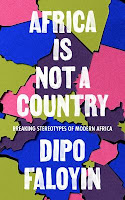
Africa Is Not a Country: Breaking stereotypes of modern Africa by Dipo Faloyin           $40
So often Africa is depicted simplistically as an arid red landscape of famines and safaris, uniquely plagued by poverty and strife. In this funny and insightful book, Dipo Faloyin offers a much-needed corrective, creating a fresh and multifaceted view of this vast continent. To unspool the inaccurate narrative, Africa Is Not A Country looks to a wide range of subjects, from chronicling urban life in Lagos and the lively West African rivalry over who makes the best Jollof rice, to the story of democracy in seven dictatorships and the dangers of white saviourism and harmful stereotypes in popular culture. It examines how each African country was formed, by white European explorers who turned up with loose maps and even looser morals, and how 90% of Africa's material cultural legacy was stolen during the colonial era. Important and very readable.
Elizabeth Finch by Julian Barnes              $40
"The task of the present is to correct our understanding of the past. And that task becomes the more urgent when the past cannot be corrected." Elizabeth Finch was a teacher, a thinker, an inspiration - always rigorous, always thoughtful. With careful empathy, she guided her students to develop meaningful ideas and to discover their centres of seriousness. As a former student unpacks her notebooks and remembers her uniquely inquisitive mind, her passion for reason resonates through the years. Her ideas unlock the philosophies of the past, and explore key events that show us how to make sense of our lives today. And underpinning them all is the story of J — Julian the Apostate, her historical soulmate and fellow challenger to the institutional and monotheistic thinking that has always threatened to divide us. Barnes's new novel is both an interrogation of the processes of memory and a celebration of liberating influence. 
"Barnes is in his element here – investigating with subtlety and gentleness the quiet mysteries that make up a life." —Guardian
Sonnets for Sio by Scott Hamilton          $25
Hamilton wrote these poems as letters to the sculptor, painter, and mystic Visesio Siasau. The poems look back on adventures the two shared amidst the jungle ruins and kava bars of Tonga, and discuss the alternately violent and beatific history of that nation. Sonnets for Sio is a book about art, goddesses, cicadas, sex, war, and intoxication. It celebrates a friendship that is intensified rather than broken by distance.
“One of the best of all our writers about the Pacific.” —Philip Matthews
“Scott Hamilton is one of the best writers and thinkers in New Zealand.” —Steve Braunias
The Stasi Poetry Circle: The creative writing class that tried to win the Cold War by Philip Oltermann             $37
Berlin, 1962. Morale is at rock bottom in East Germany, thrown into chaos by the new Berlin Wall. The Ministry for State Security is hunting for a new weapon in the war against capitalism. Rather than guns, tanks, or bombs, the Stasi resolve to fight the enemy through rhyme and verse, winning the Culture Wars through poetry. Consisting of 15 secret agents — from WW2 veterans to schoolboy recruits — the 'Working Group of Writing Chekists' met monthly from 1962 until the Wall fell. In a classroom adorned with portraits of Lenin, the spies wrote their own poetry and were taught verse, metre, and rhetoric by East German poet Uwe Berger. The regime hoped that poetry would sharpen the Stasi's 'party sword' by affirming the spies' belief in the words of Marx and Lenin, as well as strengthening the faith of their comrades. But as the agents became steeped in poetry, revelling in its imaginative ambiguity, the result was the opposite. Rather than entrenching state ideology, they began to radically question it — and, following a radical role reversal, the GDR's secret weapon dramatically backfired.
The Land of Short Sentences by Stine Pilgaard             $38
A young woman relocates to an outlying community in West Jutland, Denmark, and is forced to find her way, not only in the bewildering environment of the residential Folk High School, where her partner has been hired to teach, but also in the inscrutable conversational forms of the local population. And on top of it all, there's the small matter of juggling her roles as mother to a newborn baby and advice columnist in the local newspaper. In this understated and hilarious novel, Stine Pilgaard conjures a tale of venturing into new and uncharted land, of human relationships, dilemmas, and the perplexing byways of local social codes.
The Last Emperor of Mexico: A disaster in the New World by Edward Shawcross           $45
'One of the most monstrous enterprises in the annals of international history,' said Karl Marx. 'A madness without parallel since Don Quixote,' said a future French president. This is history's judgement on the events surrounding the ill-fated reign of Maximilian of Mexico, the young Austrian archduke who in 1864 crossed the Atlantic to assume a faraway throne. He had been convinced to do so by a duplicitous Napoleon III. Keen to spread his own interests abroad, the French emperor promised Maximilian a hero's welcome, which he would ensure with his own mighty military support. Instead, Maximilian walked into a bloody guerrilla war - and with a headful of impractical ideals and a penchant for pomp and butterflies, the so-called new emperor was singularly unequipped for the task. The ensuing saga would feature the great world leaders of the day, popes, bandits and queens; intrigue, conspiracy and cut-throat statecraft, as Mexico became the pivotal battleground in the global balance of power, between Old Europe and the burgeoning force of the New World: American imperialism.
Bacon in Moscow by James Birch             $40
This funny and personal memoir is the account of an audacious attempt by James Birch, a young British curator, to mount the ground-breaking retrospective of Francis Bacon's work at the newly refurbished Central House of Artists, Moscow in 1988. Side-lined by the British establishment, Birch found himself at the heart of a honey-trap and the focus for a picaresque cast of Soviet officials, attaches and politicians under the forbidding eye of the KGB as he attempted to bring an unseen western cultural icon to Russia during the time of 'Glasnost', just before the fall of the Berlin Wall.
"A rollicking cultural adventure before the fall of the Berlin Wall and the meteoric rise of contemporary art in the nineties." —Grayson Perry
>>Bringing the Bacon to Moscow. 
>>Dodgy plumbing.
The Social Lives of Animals: How co-operation conquered the natural world by Ashley Ward          $45
Some animal societies hold a mirror up to the human world: elephants hold funerals for departed family members. Pinyon jays run collective creches. Rats will go out of their way to help a cold, wet stranger. Other lifestyles can seem intensely alien (or maybe not so alien). Take locusts, surging over the land in their millions, unable to slow down for a moment because the hungry ranks behind will literally bite their legs off if they don't stay one step ahead.
"A great antidote to the dog-eat-dog view of nature that we grew up with. Ashley Ward takes the reader on a personal journey of discovery to make clear that animals often depend on cooperation for survival." —Frans de Waal
Faraway Girl by Fleur Beale            $24
Etta is worried about her brother, Jamie. The doctors can find nothing wrong with him, but he is getting weaker by the day. At breakfast one morning, he seems to have lost it completely - in a voice as pale as his face, he said, 'I think I can see a ghost.' However, when they all turn to look, sure enough, materialising on the window seat is a girl about Etta's age, wearing a beautiful Victorian wedding dress. Etta has to get off to school, she has no time for this, but she is about to discover that time has a whole new significance. She and her ghost companion have no choice but to work out what is going on before Jamie is lost for ever.

Matariki by Kirsten Parkinson and Kitty Brown           $23
How can we celebrate Matariki? Let's look to the stars! Maumaharatia: Remembering our past Tiakina te taiao: Caring for our environment. Te whakawhanaungatanga: Connecting with our people. 
Me pehea tatou e whakanui i a Matariki? Tirohia nga whetu! Maumaharatia te onamata. Tiakina te taiao. Te whakawhanaungatanga ki o tatou iwi. 
Explore the nine stars of Matariki in rich, detailed imagery and bilingual text. Dive into the meanings of the stars and Matariki itself. 


Friday, 6 May 2022

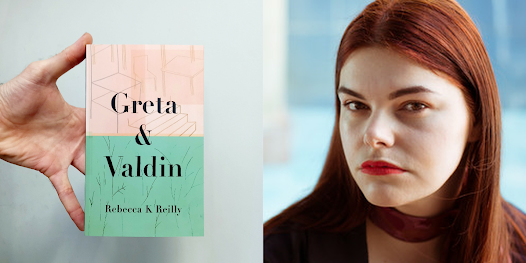
Our Book of the Week, the wholly remarkable Greta & Valdin by Rebecca K. Reilly, is an irrepressible, seemingly off-hand yet sharply insightful novel set in the queerness, nerdiness and cultural diversity of a distinctly vibrant contemporary Aotearoa. It has (unsurprisingly) been short-listed for the Jann Medlicott Acorn Prize for Fiction in the 2022 Ockham New Zealand Book Awards. 
>>Invented people on real streets — Stella interviews Rebecca K. Reilly. 
>>Read Stella's review of Greta & Valdin. 
>>What sort of pants do I wear?
>>Like an old lawnmower. 
>>The Acorn Prize round table. 
>>Infrequently asked questions. 
>>Put a straw under Baby. 
>>Videotapes.
>>Sender.
>>Time for a cultural reset. 
>>Re-Verb.
>>New notebooks.
>>Perversity, cynicism and sheer wickedness.
>>Watching, reading and listening. 
>>Gin & Vonic.
>>Your copy of Greta & Valdin. 
>>Other books short-listed for the 2022 Ockham New Zealand Book Awards. 

Wednesday, 4 May 2022


INVENTED PEOPLE ON REAL STREETS
An interview with REBECCA K. REILLY
author of GRETA & VALDIN


Stella: Greta & Valdin has been a sensation — topping the indie bestseller charts and capturing a rapturous audience. Why do you think it has been so well received?

Rebecca: Oh, I mean, I think only some of a book’s numbers are down to writing. It has to be in the right hands at the right time and have ticked a whole lot of boxes like inoffensive blurb, cover that doesn’t clash in a flat lay, author photo where the writer doesn’t look too furious. Then on top of that you need word of mouth recommendations, so the content of the book has to be okay as well. Here this book has good fortune because it doesn’t really have objectionable content in it, so if the reader enjoys it they can pretty much recommend it freely except to people who are homophobic or have a vested interest in preserving Iberian Spanish. Or people who tend to err on the side of finding any kind of vague angle of intellectualism pretentious and classist, this nerd book is not for them. One of my favourite books is Bear by Marian Engels and I can’t recommend it to many people at all because you have to be chill about what I guess we can call theoretical zoophilia here.

Stella: While reading this, I was actually aware of the balance you strike in keeping the lively energy of the protagonists (and the cityscape they live in — the city is vividly portrayed) front and centre while simultaneously delving into deeper themes on race and gender.  Do you think humour is a vital tool in your kete? And where is it most useful or most successfully employed? Can it also, in contrast, obscure the intent of the writer?

Rebecca: I think balance is the key for me here. When I’m editing, I’m mostly thinking about how I can achieve a balance of entertainment and, ugh, pathos I guess? I want to feed the reader the vegetables (the gay agenda) a little bit but I mainly want to do what’s best to make an entertaining story with emotional highs and lows. I think it would be disingenuous to leave out the political realities that people like the characters in the book have to live with, but I’m not, you know, I’m not in the business of achieving social justice through opaque messaging. We don’t need books for that, we have the Instagram explore page.

I guess humour is good when trying to squeeze through material that’s difficult somehow, dense or dull but necessary structurally, or just straight out painful. I am aware that what I’m writing in a manuscript is intended for public consumption so I’m purposefully trying not to obscure my intentions with weird edgy jokes. Sometimes I think of something that would be funny but it’s too much, which I don’t see as self-censorship but rather a form of curation. I save that stuff for my edgy personal associates.

Stella: Love is a central theme to the book, whether that is raw and new or more nuanced and convoluted. At times, your novel seemed to sit alongside a Sally Rooney work, while at other times a classic Austen, Dickens (all those machinations) or a Russian meld of Chekhov and Tolstoy. What do you think?

Rebecca: Ah, I think the book is kind of tricky in this way. It does sit alongside the novels of Sally Rooney, Naoise Dolan, Laura McPhee-Browne and others because in a way, I’m also this kind of writer, I was born at the same time and I’ve spent many years at university and wear midi skirts. But I can’t say that I was influenced by millennial novelists at all, because when I wrote this book I was very out of touch with what was going on culturally with novels. I read all these books after I wrote mine. I think I’m this genre of writer circumstantially, but. . . taller and indigenous and from a different country.

I got an Austen comparison on my original manuscript for this book by the examiner, but I didn’t really know what it meant because I have never read the work of Jane Austen. My grandmother had the BBC adaptation on video and I watched one of the videos, I guess twenty years ago. I’ve never read Dickens either, I just know enough about these things to yell five sisters or Ebenezer when I’m watching The Chase. I’ve never read a Russian novel either, actually. I’ve read Uncle Vanya and The Cherry Tree. I’ve seen a production of The Pōhutukawa Tree.

I think I’ve just always been interested in convoluted plots with many mysterious characters and motives, the first time I was asked to move onto a new project rather than writing one never-ending story was in Year 1 when I filled up a whole exercise book with my story We’re Going to Invercargill, a place I had heard mentioned approximately one time. I think this is maybe what happens when you have an autistic child who likes writing but has no interest in fantasy or science fiction or non-fiction. Just this elaborate take on social realism. I used to play limb centre with my dolls, after going with my dad to pick up a new prosthetic leg once. Now I’m an adult who can invent new people and situations from scratch but would be extremely pressed to make them exist on streets that aren’t real. I’m sorry, I haven’t said anything about love – I like thinking about how love works and how people relate to one another, what sort of forms that can take, how far it can stretch. It’s an interesting area of thought like oceanography or linguistics.

Stella: Your book has a happy ending — mostly. Did you intend this?

Rebecca: The end of the book is definitely the part I’ve had the most negs about (rushed, messy, loses it, but also overly neat, unrealistic, cutesy) but I did intend it to be how it is. I know the author’s intention doesn’t matter and it’s all up to the reader, but here my intention was not to show a happy ending as such, but a not-horrible ending for my two protagonists. You know, in the queer community and in the Māori community we’ve got enough media where something cooked happens to the characters right at the end. This is not a book where people are drowning or going to jail or revealing they’re actually straight-engaged to someone else at the end. My secondary intention was to show that although maybe everything is momentarily fine in the world of the protagonists, they also needed to realise that the world, and even the people closest to them, operate on their own terms without their intervention. I wanted to break from the insularity of the tight first person and show that other stuff was going on and other characters had different viewpoints and other things they were dealing with.

I’m interested in the narrative perspective of Less, by Andrew Sean Greer, where the third-person narrator turns out to be someone in love with the protagonist and A Series of Unfortunate Events where the narrator is in love with someone who turns out to be the deceased mother of the protagonists. I wanted this type of effect as well, for my own Beatrice, a smaller version of it, not directly through narration but an absence of it. From one perspective, this book is a year in the life of a woman who has a lot going on socially and emotionally, but we only ever hear about it from the perspectives of two of her children, one who has no idea what she’s up to and one who seems like he might actually, but he just doesn’t think about it. He’s got a lot on too and has strong reasons for not thinking too much into the affairs of his mother because they affect him too much.

I don’t know, I think that this thing I’m trying to do is definitely a two-book job and I don’t regret sowing the seeds into the first book even if I can never be bothered doing the second one and a fraction of people just think I’m shit at writing endings. They don’t know what’s in my mind. I’m a real shocker for putting information for one text in another, I wrote a short story for Starling set the year before this book and V says that when he turns thirty he’ll simply stop mentioning his age. Which he does, in Greta & Valdin, he says that he’s 29 and that it’s his birthday the next month several times in the first few chapters and then he never mentions it again. I’m just giving away information at this point because the book came out a year ago next week and I would like to stop talking about this one soon and move onto the next one, I’m shit at multi-tasking. Anyway, all the things I’ve done have been worth the risk, would trade again.